Tag Archives: GenerativeAI

When AI Knows the HOW, Education Must Teach the WHY

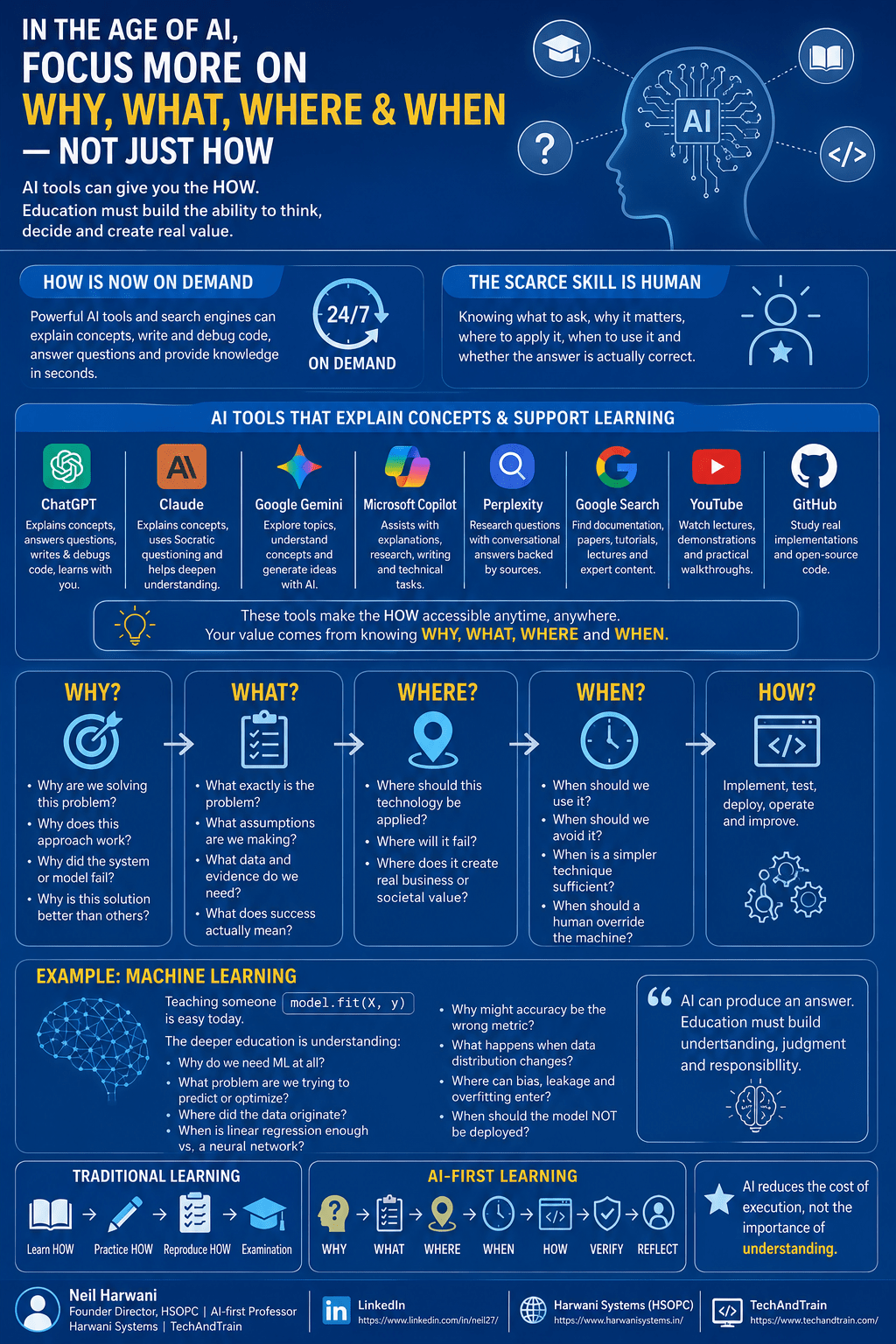
In the age of AI, should education spend more time on WHY, WHAT, WHERE and WHEN — rather than only HOW?

For decades, technical education has focused heavily on HOW.

How do you write the code? How do you implement an algorithm? How do you calculate the answer? How do you configure or deploy the system?

HOW still matters — but access to HOW has fundamentally changed.

Today, a learner can ask:

  • ChatGPT — explain concepts, reason through problems, learn math/science, write and debug code.
  • Claude — explain concepts, ask Socratic questions and help develop understanding.
  • Google Gemini — explore and understand topics using generative AI.
  • Microsoft Copilot — assist with explanations, research, writing and technical work.
  • Perplexity — research questions through conversational answers backed by sources.
  • Google Search — find documentation, papers, tutorials, lectures and expert discussions.
  • YouTube — access lectures, demonstrations and practical walkthroughs.
  • GitHub — study real implementations and open-source code.

ChatGPT explicitly supports answering questions and explaining concepts, while Anthropic’s education work with Claude emphasizes guiding students, Socratic questioning and understanding fundamental principles.

So HOW is increasingly available on demand.

The scarce skill is increasingly knowing what to ask, why it matters, where to apply it, when to use it — and whether the answer is actually correct.

WHY?

Why are we solving this problem? Why does this technique work? Why did the system or model fail? Why is this solution preferable to another?

WHAT?

What exactly is the problem? What assumptions are being made? What data do we need? What does success actually mean?

WHERE?

Where should this technology be applied? Where will it fail? Where does it create genuine business or societal value?

WHEN?

When should we use it? When should we avoid it? When is a simpler technique sufficient? When should a human override the machine?

And then — HOW?

How do we implement, test, deploy, operate and improve it?

Consider Machine Learning.

Teaching someone:

model.fit(X, y)

is relatively easy today.

The deeper education is:

WHY do we need ML at all? → WHAT problem are we actually trying to predict or optimize? → WHERE did the data originate? → WHEN is linear regression sufficient instead of a neural network? → Why might accuracy be the wrong metric? → What happens when the data distribution changes? → Where can bias, leakage and overfitting enter the system? → When should the model not be deployed?

This distinction becomes even more important because AI assistance can produce an answer without guaranteeing that the learner understands it. Anthropic’s research on coding education found stronger mastery among participants who used AI to build comprehension — asking conceptual questions and requesting explanations — rather than simply using it to produce code.

That suggests a different model for education:

Traditional: Learn HOW → Practice HOW → Reproduce HOW → Examination

AI-first learning: WHY → WHAT → WHERE → WHEN → HOW → VERIFY → REFLECT

AI can dramatically reduce the cost and time of HOW.

But it increases the importance of fundamentals, judgment, context, critical thinking, verification and responsibility.

The future of education should therefore not be about teaching students less because AI exists.

It should be about teaching them to think at a higher level because AI exists.

AI should reduce the cost of execution — not the importance of understanding.

Neil Harwani

🔗 LinkedIn: https://www.linkedin.com/in/neil27/ 🔗 Harwani Systems (HSOPC): https://www.harwanisystems.in/ 🔗 TechAndTrain: https://www.techandtrain.com/

#AI #Education #AIFirst #MachineLearning #DataScience #GenerativeAI #Teaching #Learning #CriticalThinking #HigherEducation #Engineering #Technology #FutureOfEducation

Concept & Narrative Credit: Neil Harwani

Creation Help: ChatGPT

📢 Stay informed:

From Transformers to AI Agents: Practical Roadmap to Modern Large Language Models (LLMs) – Faculty Development Program at Rashtriya Raksha University

From Transformers to AI Agents: Practical Roadmap to Modern Large Language Models (LLMs) – Notes from Faculty Development Program / Short Term Training Program (Generative AI – From Foundations to Frontiers) that I attended at Rashtriya Raksha University

Article content
Article content

Artificial Intelligence is evolving rapidly. What began with language prediction has now expanded into multimodal reasoning, autonomous agents, and enterprise AI systems. Understanding the complete ecosystem—not just ChatGPT—is becoming an essential skill for engineers, researchers, architects, and business leaders.

1. LLM Internals – How an LLM Actually Works

  • Data collection → cleaning → tokenization
  • Tokens converted into embeddings (dense vectors)
  • Positional encoding preserves sequence information
  • Transformer architecture using:
  • Next-token prediction using Softmax probabilities
  • Training via gradient descent and backpropagation
  • Inference through autoregressive generation

Key idea: LLMs do not memorize sentences—they learn statistical relationships among billions of tokens.


2. Mathematics Behind LLMs

Modern LLMs combine mathematics from multiple disciplines:

  • Linear Algebra (vectors, matrices, tensors)
  • Calculus (gradients, derivatives)
  • Probability & Statistics
  • Information Theory (Entropy, Cross-Entropy)
  • Optimization (Gradient Descent, Adam)
  • Graph Theory
  • Numerical Computing
  • High-dimensional Geometry

Core mathematical concepts

  • Embeddings
  • Attention mechanism
  • Softmax
  • Loss functions
  • Cosine similarity
  • Matrix multiplication
  • Eigenvectors & Singular Value Decomposition (SVD)

Mathematics remains the foundation behind every AI model.


3. Multimodal LLMs

Today’s AI models understand much more than text.

They can process:

  • Text
  • Images
  • Audio
  • Video
  • Documents (PDFs)
  • Tables
  • Source code
  • Structured enterprise data

Applications include:

  • Medical diagnostics
  • Autonomous vehicles
  • Satellite & GeoAI
  • Robotics
  • Scientific research
  • Digital assistants

4. Fine-Tuning

Organizations often adapt foundation models to their specific domains.

Popular approaches include:

  • Full Fine-Tuning
  • Parameter-Efficient Fine-Tuning (PEFT)
  • LoRA
  • QLoRA
  • Instruction Tuning
  • Reinforcement Learning from Human Feedback (RLHF)
  • Preference Optimization (e.g., DPO)

Fine-tuning helps models learn organizational knowledge, terminology, and task-specific behavior.


5. Enterprise Applications

LLMs are transforming almost every industry.

Examples include:

  • Customer support
  • Knowledge management
  • Software development
  • Healthcare
  • Finance
  • Manufacturing
  • Legal document analysis
  • Education
  • Cybersecurity
  • Scientific discovery
  • Government services
  • Geospatial intelligence (GeoAI)

6. Retrieval-Augmented Generation (RAG)

Instead of relying only on training knowledge, RAG retrieves relevant information before generating a response.

Typical pipeline: Documents → Chunking → Embeddings → Vector Database → Retrieval → Prompt Construction → LLM → Answer

Benefits:

  • More accurate responses
  • Reduced hallucinations
  • Access to current enterprise knowledge
  • Better explainability

7. Common RAG Patterns

Modern RAG systems use increasingly sophisticated architectures.

Examples include:

  • Naïve RAG
  • Semantic Search RAG
  • Hybrid Search (Keyword + Vector)
  • Parent–Child Retrieval
  • Multi-Vector Retrieval
  • Graph RAG
  • Knowledge Graph RAG
  • Agentic RAG
  • Corrective RAG (CRAG)
  • Self-RAG
  • Multi-hop RAG
  • Hierarchical RAG
  • Multimodal RAG

The trend is shifting from “search then answer” to intelligent reasoning over enterprise knowledge.


8. AI Agents

Unlike traditional chatbots, AI agents can plan, reason, and execute tasks.

Agent capabilities include:

  • Planning
  • Tool usage
  • Multi-step reasoning
  • Memory
  • Reflection
  • Self-correction
  • Collaboration with other agents

Common frameworks:

  • LangGraph
  • CrewAI
  • AutoGen
  • Semantic Kernel
  • OpenAI Agents SDK

Agents are moving AI from conversation to autonomous execution.


9. Model Context Protocol (MCP)

MCP is emerging as a standardized way for AI models to interact with external systems.

It enables models to securely connect with:

  • Databases
  • APIs
  • Git repositories
  • Local files
  • Enterprise applications
  • Business workflows
  • Development tools

Think of MCP as a “USB-C for AI,” providing a common interface between models and tools.


10. Ethics & Responsible AI

As AI capabilities expand, responsible development becomes increasingly important.

Key principles:

  • Fairness
  • Transparency
  • Explainability
  • Privacy
  • Security
  • Bias mitigation
  • Human oversight
  • Accountability
  • Regulatory compliance
  • Sustainability

Responsible AI is not optional—it is fundamental to building trustworthy systems.


Final Thoughts

The future of AI lies at the intersection of Transformers, Mathematics, Multimodal Intelligence, Fine-Tuning, RAG, AI Agents, MCP, and Responsible AI. Professionals who understand these interconnected concepts will be well-positioned to design the next generation of intelligent systems that are accurate, scalable, secure, and impactful.

The next wave of AI is not just about larger models—it is about smarter architectures, richer context, reliable reasoning, and responsible deployment.

Here is a curated list of technical keywords from the topics in this FDP & Article:

LLM Internals & Mathematics

  • Self-Attention Mechanism
  • Transformer Architecture
  • Positional Encoding (e.g., RoPE)
  • Softmax Function
  • Gradient Descent
  • Cross-Entropy Loss
  • Backpropagation
  • Stochastic Gradient Descent (SGD)
  • Backprop-through-time (BPTT)
  • Layer Normalization

Multi-Modal LLMs

  • Cross-Attention
  • Vision-Language Pre-training (VLP)
  • Contrastive Learning (e.g., CLIP)
  • Modality Alignment
  • Vector Quantization

Fine-Tuning

  • Parameter-Efficient Fine-Tuning (PEFT)
  • Low-Rank Adaptation (LoRA)
  • Quantized LoRA (QLoRA)
  • Reinforcement Learning from Human Feedback (RLHF)
  • Direct Preference Optimization (DPO)
  • Supervised Fine-Tuning (SFT)

Applications & RAG (Retrieval-Augmented Generation) Patterns

  • Vector Embeddings
  • Cosine Similarity
  • Approximate Nearest Neighbor (ANN)
  • Dense Retrieval
  • Hybrid Search (Lexical + Semantic)
  • Re-ranking Models (Cross-Encoders)
  • Context Window Constraints
  • Query Transformation

Agents & MCP (Model Context Protocol)

  • ReAct Framework (Reasoning and Acting)
  • Tool Calling / Function Calling
  • Autonomous Agents
  • Chain-of-Thought (CoT)
  • Model Context Protocol (MCP)
  • State Machine Routing

Ethics in AI

  • Algorithmic Bias
  • Differential Privacy
  • Alignment Problem
  • Data Provenance
  • Hallucination Mitigation
  • Toxicity Scoring

Thank you to all the speakers and staff at RRU.

Dr. Ravi Sheth | LinkedIn School of Information Technology, Artificial Intelligence and Cyber Security (SITAICS): Overview | LinkedIn Gujarat Council on Science and Technology (GUJCOST) | LinkedIn Government of Gujarat: Overview | LinkedIn Rashtriya Raksha University: Overview | LinkedIn Ankita Kapadia | LinkedIn Ankush Chander | LinkedIn Sandip Modha | LinkedIn Bhavesh Patel | LinkedIn Dr. Nikunj Tahilramani | LinkedIn Pragnesh Prajapati | LinkedIn Nirali Khoda | LinkedIn Rajesh Gupta | LinkedIn Mayur Makwana | LinkedIn Dr. Chandresh Parekh | LinkedIn

#ArtificialIntelligence #GenerativeAI #LLM #MachineLearning #DataScience #RAG #AIAgents #MCP #ResponsibleAI #GeoAI #DeepLearning #Research #HigherEducation #EnterpriseAI #FutureOfWork

Concept Credit: Neil Harwani (Article) & Rashtriya Raksha University (FDP / Short term course)

Creation Help: ChatGPT, XMind and Gemini

📢 Stay informed:

Dimensions for Artificial Intelligence / GenAI / LLMs / Deep Learning / Neural Networks / Data Science to ponder on – Part 1-Assisted by AI – ChatGPT


🧠 1. Model Performance & Quality

Beyond accuracy:

  • Precision / Recall / F1-score
  • ROC-AUC
  • Calibration (probability correctness)
  • Generalization ability
  • Robustness (noise, adversarial inputs)
  • Stability (variance across runs)
  • Overfitting / Underfitting control
  • Latency (response time)
  • Throughput (requests per second)

⚖️ 2. Responsible AI / Ethics

Along with fairness, bias, explainability, interpretability:

  • Accountability
  • Transparency
  • Non-discrimination
  • Inclusiveness
  • Human oversight / Human-in-the-loop
  • Ethical alignment
  • Value alignment (especially for LLMs)
  • Safety (harm prevention)

🔐 3. Security & Privacy

Critical for enterprise and GenAI:

  • Data privacy (PII protection)
  • Differential privacy
  • Federated learning capability
  • Model security (model theft, extraction)
  • Prompt injection resistance (LLMs)
  • Data leakage prevention
  • Adversarial robustness
  • Access control & authentication

📊 4. Data Quality & Governance

Often more important than model itself:

  • Data completeness
  • Data consistency
  • Data lineage
  • Data drift detection
  • Concept drift detection
  • Bias in training data
  • Data freshness
  • Label quality
  • Auditability

⚙️ 5. Model Lifecycle & MLOps

Operational excellence:

  • Reproducibility
  • Versioning (data + model)
  • Monitoring (real-time + batch)
  • Model retraining strategy
  • Deployment reliability
  • Rollback capability
  • CI/CD for ML pipelines
  • Observability (logs, metrics, traces)

🧩 6. LLM / GenAI Specific Parameters

Very important for your GenAI work:

  • Hallucination rate
  • Faithfulness (groundedness to source)
  • Context retention (long context handling)
  • Instruction following
  • Toxicity / harmful output control
  • Prompt sensitivity
  • Response consistency
  • Token efficiency (cost optimization)
  • Alignment with system prompts / policies
  • Retrieval quality (RAG precision/recall)

🧪 7. Evaluation & Testing

For enterprise-grade systems:

  • Benchmarking (standard datasets)
  • Stress testing
  • Edge case coverage
  • Scenario testing
  • A/B testing
  • Human evaluation (subjective scoring)
  • Red teaming (especially for GenAI)

🌐 8. Business & Product Metrics

Often ignored in technical discussions:

  • ROI / Cost-benefit
  • User satisfaction
  • Adoption rate
  • Time saved / productivity gain
  • Decision impact quality
  • Revenue impact
  • Risk reduction

🧭 9. Governance & Compliance

Especially relevant in India (DPDP Act etc.):

  • Regulatory compliance
  • Audit trails
  • Model documentation (Model Cards)
  • Explainability for regulators
  • Consent management
  • Data residency

🧠 Quick Memory Framework

You can compress everything into:

👉 FAPES-DLMGB

  • Fairness & Ethics
  • Accuracy & Performance
  • Privacy & Security
  • Explainability
  • Scalability & Stability
  • Data Quality
  • Lifecycle (MLOps)
  • Monitoring
  • Governance
  • Business Impact

Reference frameworks:

  • NIST AI Risk Management Framework
  • ISO/IEC 42001

Note: Enhanced / compiled with help of AI / LLMs