Tag Archives: AI

🚕 From Traffic Prediction to Decision Intelligence — A Graph ML Story

Below are insights from my open book assignment / exam at IIT GNX converted into a blog-based story with help on AI/GenAI. This was the most exciting open book assignment / exam given by me till now. Open to comments, suggestions, ideas, debates, improvements, corrections, reviews, etc. Feel free to email me (refer contact detail in the bottom of this article) or message me on LinkedIn.

📌 The Real Question Isn’t Prediction — It’s Decision

Most data science projects stop at:

“Model accuracy improved.”

But in real systems—especially ride-hailing, logistics, BFSI, or infra platforms—that’s not enough.

The real question is:

What decision becomes better because of this model?

This assignment pushed me to think differently.

Instead of just predicting traffic, I asked:

How can traffic forecasts drive real operational decisions in a ride-hailing system?


🧠 Problem Framing (What Actually Matters)

We used the METR-LA dataset:

  • 207 traffic sensors
  • 5-minute interval readings
  • ~4 months of data
  • Objective: predict traffic speeds 5, 15, 30 minutes ahead

But here’s the twist:

👉 Each sensor is not independent 👉 Roads are connected systems 👉 Congestion spreads like a graph

So instead of treating data as rows in a table…

We treat it as a graph system


🌐 Thinking in Graphs (Systems Thinking)

  • Nodes → Traffic sensors
  • Edges → Road proximity / connectivity
  • Signals → Speed over time

This is where complex systems + spatial thinking come into play.

Traffic ≠ isolated events Traffic = propagating behavior across a network


📊 What the Data Told Us

From exploratory analysis:

  • Congestion appears in clusters (not random points)
  • Patterns repeat during commute peaks
  • Slowdowns are both: Temporal (time-based) Spatial (location-based)

👉 This is critical insight for operations:

  • Time tells you when to act
  • Space tells you where to act

🤖 Models We Tested (Keep It Honest)

To make this real (not overhyped), we compared:

1. Persistence Model

  • “Tomorrow ≈ Today”
  • Surprisingly strong for 5-minute prediction

2. Random Forest

  • Uses past lag features
  • Captures non-linear temporal patterns

3. Graph ML Model (GConvGRU)

  • Combines: Graph Convolution → spatial relationships GRU → temporal dynamics

📈 Results (Where Graph ML Actually Matters)

From the results:

Horizon Best Insight (Labels)

5 min Simple models work well

15 min Graph ML starts winning

30 min Graph ML clearly better

👉 Why?

Because:

Short-term = inertia Medium-term = propagation

Graph models capture how congestion spreads, not just how it exists.


🚕 Turning Predictions into Decisions

This is where the project becomes real.

🔴 If congestion is predicted in next 15–30 mins:

  • Reduce driver inflow into that corridor
  • Increase ETA buffers
  • Trigger incentives in nearby zones

🟢 What this enables:

  • Better ETA reliability
  • Smarter driver utilization
  • Reduced customer wait time
  • Proactive—not reactive—operations

🧩 The Big Shift: Model → Decision System

This project is NOT just:

“Train model → predict → done”

It is:

EDA → Model → Evaluation → Business Rules → Decision Intelligence

The work is framed as a decision-intelligence exercise rather than only model-building


⚠️ Reality Check (Limitations)

Let’s stay grounded.

The dataset does NOT include:

  • Ride demand
  • Driver availability
  • Weather
  • Events
  • Airport queues

So:

This is traffic intelligence, not full business optimization


🔧 What I Learned (Real Engineering Insights)

From my own notes:

  • Training time is real (hours, not minutes)
  • GPU/TPU selection matters
  • Early stopping is critical (overfitting is silent killer)
  • Graph ML pipelines are non-trivial systems
  • LLMs can accelerate development—but thinking is still yours

🏗️ Architecture Thinking (My Take)

What excites me most is not the model.

It’s the system design potential:

Imagine combining this with:

  • Real-time driver GPS
  • Demand prediction models
  • Event/weather APIs
  • Reinforcement learning for dispatch

👉 You get:

Autonomous Decision Systems for Urban Mobility


🔮 Where This Connects to My Larger Work

This directly aligns with what I’m exploring:

Agentic AI + Graph Systems + Probabilistic Models for Autonomous Debugging & Decision Systems

Traffic is just one domain.

Same thinking applies to:

  • Microservices failures
  • Network congestion
  • Financial risk propagation
  • Supply chain disruptions

🧠 Final Thought

A staff engineer once asked:

“What gets harder after this lands?”

For me, this project answered a deeper question:

What gets smarter after this lands?


📌 Bottom Line

  • Graph ML is not just “better ML”
  • It is better system understanding
  • Real value comes when: Predictions → Decisions Models → Actions Data → Intelligence

📢 Stay informed:


#GraphML #DataScience #AI #SpatialDataScience #RideHailing #DecisionIntelligence #SystemsThinking #GNN #MachineLearning #TechLeadership

Learnings from assignments / open book exams at Indian Institute of Technology Gandhinagar – Executive Masters in Data Science for Decision Making

One important lesson I learned while working with spatio-temporal graph data on the METR-LA dataset during my Executive Masters open-book assignment:

Do not keep switching between Claude, ChatGPT, Perplexity, Gemini, and other LLMs or AI tools during the execution stage. This lesson has repeated itself in the two years throughout the Executive Masters whenever we have been allowed to use LLMs.

My learning:

• Different LLMs reason differently

• They are trained and fine-tuned differently

• They suggest different libraries, assumptions, fixes, and coding styles

• Mixing their guidance during debugging can create unnecessary chaos

• What looks like “more intelligence” can become “more confusion”

• Multi-model thinking is useful during brainstorming

• It helps in debating, exploring, comparing, and expanding ideas

• But once execution begins, consistency matters more than variety

• Pick one model and work through the problem step by step

• Ask it to explain, debug, simplify, correct, and iterate

• Stay with one reasoning path until the solution stabilizes

My conclusion:

Use multiple LLMs for exploration.

Use one LLM for execution.

Mixing models during ideation can create insight.

Mixing models during implementation can create chaos.

This is especially true in technical work involving data science, graph ML, spatio-temporal modeling, package dependencies, tensor shapes, runtime environments, and debugging.

Progress comes from disciplined iteration, not tool-hopping.

Note: Enhanced / compiled with help of AI / LLMs

How can portals & commerce have intelligence via LLMs/GAI/ChatGPT/Gemini/etc. – Part 1

Here is my solution template for having intelligence from AI/GAI/LLMs in Portals & Commerce – Part 1:

  • Assumptions: Java/PHP/Dot Net/SharePoint/Liferay/WordPress/Drupal type of a portal and / or commerce
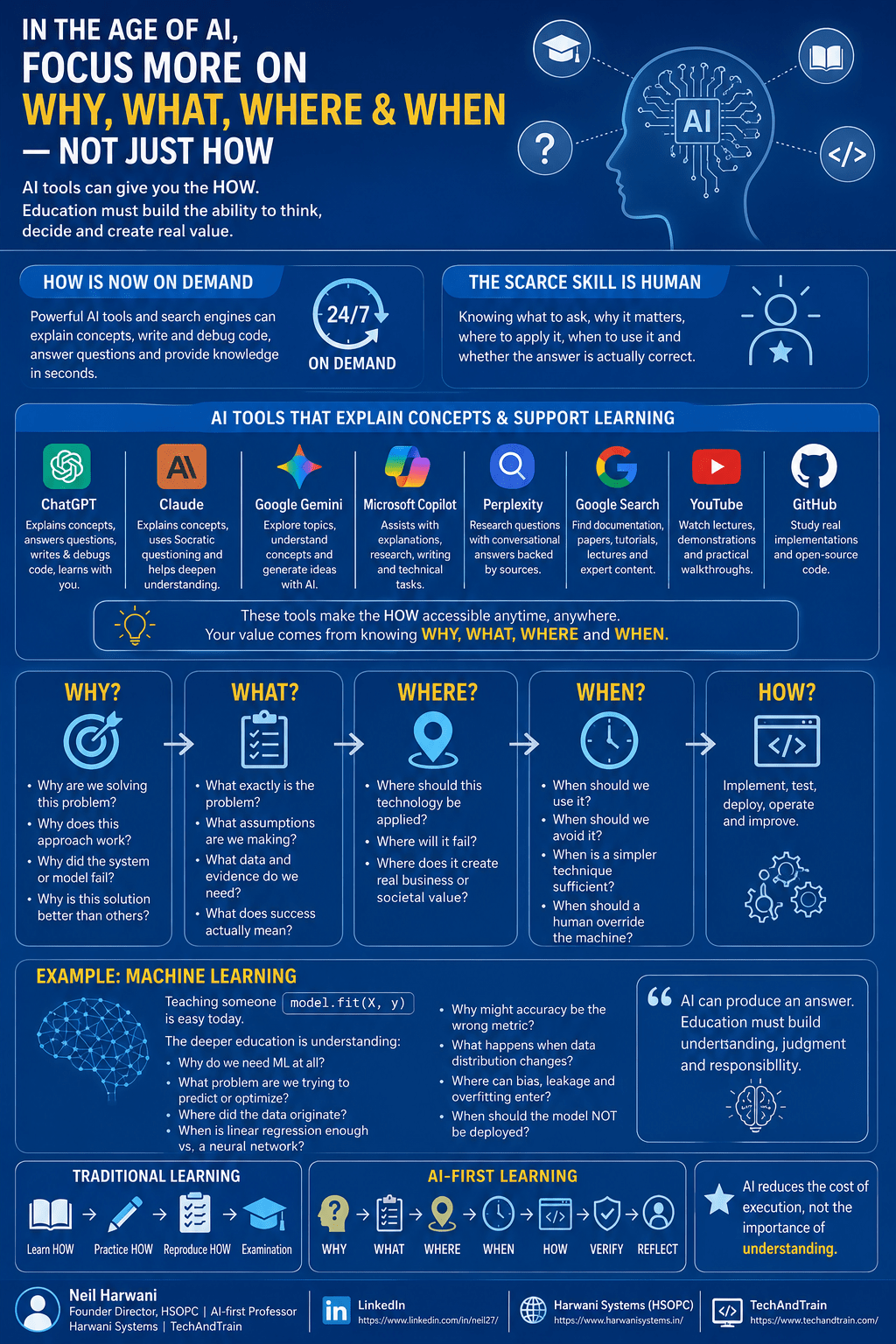
  • Just like we have HTML – HEAD / BODY / FOOTER / HEADER / META TAGS / BACKEND LOGIC in Java / Front end JSP / etc. in web applications, let’s say we define a section in HEAD / META / etc. to contextualize the page and it’s content – WHAT, WHY, WHERE, WHEN, HOW, etc.? Right now in classic HTML / Java / JSP we define Meta tags and actual content but no semantics / context / etc. Till now it was fine because we could manage with search engines, basic chatbots and so on.
  • What these new tags and standard does is it gives context for ChatBots, Agents & LLMs/GAI/ChatGPT/Gemini and so on. Now these AI systems can talk to these pages and users on it with a context which immediately results in much better intelligence.
  • How do we define intelligence for above components:
  • Context sensitive help
  • Context sensitive agentic work
  • Semantic / contextual / relevance-based flow suggestions of usage of system pages
  • Automated suggestions on shopping
  • Context sensitive content generation
  • Use cases are endless and all these get enabled at GAI/LLMs/Agentic level instead of customized baking in the product or customizations. This is a repeat of Google / Bing / Yahoo search but at AI level
  • What this basically does is it adds context to all the pages and the portal or commerce as a whole.
  • Also, it removes to a large extent though not fully the need to continuously generate training data for the integrated intelligence as context is prebuilt along with meta tags and actual content.
  • This could be a larger standard under Mozilla / Apache Foundation or IETF or similar to enhance our web to the new world beyond simple search which is agents and LLMs / GAI / AI. Whole web could slowly become context aware along with content and meta tags. We are enhancing the META DATA itself on the web with this. All we have to do is add context and the SUPER AI like agents / LLMs / GAI will do the rest on their own.
  • Various plugins with governance and privacy for nonpublic sites could be thought off.

Enterprise Content Management & Artificial Intelligence Use cases – Part 1

  • Enterprise content management – Wikipedia – Enteprise Content Management on Wikipedia – Enterprise content management (ECM) extends the concept of content management by adding a timeline for each content item and, possibly, enforcing processes for its creation, approval, and distribution. Systems using ECM generally provide a secure repository for managed items, analog or digital. They also include one (or more) methods for importing content to bring manage new items, and several presentation methods to make items available for use. Quoted from WIKIPEDIA.
  • List of content management systems – Wikipedia – List of Enterprise Content Management systems on Wikipedia
  • Artificial intelligence – Wikipedia – Artificial Intelligence on Wikipedia

List of use cases from AI overlapping with Enterprise Content Management:

1. Document classification, automated categorization, tagging and taxonomy

2. Intelligent scanning and capture

3. Handwriting recognition

4. Process / workflow automation & intelligence

5. Recommendations from documents and content

6. Knowledge management

7. Personalization & security

8. Content / image extraction and context creation

9. Automated and intelligent lifecycle management for records, archives and content

10. Document and content analytics

11. Publishing controls

12. Content & document generation

13. Low code ECM

These and more use cases in Enterprise Content Management will get enhanced with AI over the course of next few years.

Email me: Neil@HarwaniSystems.in