Tag Archives: DataScience

Sunday Mathematics #3 — Complex Numbers: When Real Numbers Are Not Enough

Article content

Most of us first encounter complex numbers through a slightly uncomfortable equation:

x² + 1 = 0

Therefore:

x² = −1

But no real number squared gives −1.

Mathematics solved this by extending the number system and defining:

i = √−1

A complex number can therefore be written as:

z = a + bi

where:

  • a is the real part
  • b is the imaginary part
  • i² = −1

At first glance, this can look like a mathematical trick.

It isn’t.

Complex numbers are one of the most useful mathematical abstractions in science, engineering and computing.


1. From a Number Line to a Number Plane

Real numbers live on a one-dimensional number line.

Complex numbers give us a two-dimensional plane:

z = a + bi ↔ (a, b)

The horizontal axis represents the real component and the vertical axis represents the imaginary component.

For example:

z = 3 + 4i

can be represented by the point (3,4).

Its magnitude is:

|z| = √(3² + 4²) = 5

Its angle or phase is:

θ = tan⁻¹(4/3)

So a complex number can represent both:

Magnitude + Direction

This is where complex numbers become extraordinarily useful.


2. Cartesian and Polar Forms

The same complex number can be represented in different ways.

Cartesian form

z = a + bi

Polar form

z = r(cos θ + i sin θ)

where:

r = √(a² + b²)

Using Euler’s formula:

e^(iθ) = cos θ + i sin θ

we get:

z = re^(iθ)

This is a remarkably powerful representation.

Instead of thinking only about two numbers, we can think in terms of:

Amplitude + Phase

And amplitude and phase appear everywhere in physical and computational systems.


3. Euler’s Formula — A Beautiful Mathematical Bridge

One of the most famous equations in mathematics is:

e^(iπ) + 1 = 0

It connects five fundamental mathematical constants:

0, 1, e, i and π

But Euler’s formula is much more than mathematical beauty.

e^(iθ) = cos θ + i sin θ

provides a bridge between:

exponentials ↔ trigonometry ↔ rotation ↔ oscillation

That bridge is extremely useful when studying waves, signals, electrical systems, communications and control systems.


4. Complex Numbers and Rotation

Suppose:

z = re^(iθ)

Multiplying it by:

e^(iφ)

gives:

z’ = re^(i(θ+φ))

In simple terms, multiplication by a complex exponential can rotate a point.

This gives us a very elegant mathematical mechanism for representing rotations.

Instead of repeatedly manipulating sine and cosine equations, many rotation and oscillation problems become multiplication problems.

This idea appears in graphics, robotics, signal processing, physics and engineering.


5. Electrical Engineering and AC Circuits

One of the classic applications of complex numbers is alternating-current circuit analysis.

Electrical quantities such as voltage and current oscillate.

Instead of repeatedly working with expressions such as:

V(t) = V₀ cos(ωt + φ)

engineers can represent oscillating quantities using complex numbers and phasors.

Circuit impedance can be represented as:

Z = R + jX

where:

  • R = resistance
  • X = reactance
  • j represents √−1 in electrical engineering

The magnitude tells us the overall opposition to current, while the phase captures the relationship between voltage and current.

A difficult time-domain problem can often become a much simpler algebraic problem.


6. Signal Processing and Fourier Analysis

Suppose we have audio, vibration, radar, network or sensor data.

A signal that looks complicated in the time domain may actually contain combinations of simpler frequencies.

Fourier analysis decomposes signals into these frequency components.

Complex exponentials provide an elegant representation:

e^(iωt) = cos(ωt) + i sin(ωt)

This idea forms part of the mathematical foundation behind tools such as:

Fourier Transform

Discrete Fourier Transform (DFT)

Fast Fourier Transform (FFT)

These are used across:

  • Audio processing
  • Image processing
  • Telecommunications
  • Radar
  • Medical imaging
  • Vibration analysis
  • Sensor analytics
  • Spectral analysis
  • Scientific computing

Complex numbers therefore help us move between:

Time Domain ↔ Frequency Domain


7. Communication Systems

Modern communication systems depend heavily on amplitude and phase.

Wireless systems can encode information by changing these properties of a carrier signal.

For example, in Quadrature Amplitude Modulation (QAM), symbols can naturally be represented as points on a complex plane.

Think of a transmitted symbol as:

z = I + jQ

where:

  • I = In-phase component
  • Q = Quadrature component

The constellation of these complex-valued points represents digital information.

So when your phone communicates using sophisticated wireless networks, complex-number mathematics is operating underneath many layers of abstraction.


8. Control Systems

Complex numbers also appear naturally when studying the stability and behaviour of dynamic systems.

Engineers examine poles and zeros in the complex plane.

A pole might look like:

s = σ + jω

The real component can tell us about growth or decay.

The imaginary component relates to oscillation.

This makes the complex plane extremely useful for reasoning about:

Stability + Oscillation + Damping + System Response

Applications range from industrial automation to aerospace, robotics and power systems.


9. Quantum Mechanics

Complex numbers are fundamental to quantum mechanics.

Quantum states are represented using complex-valued wave functions.

A simplified representation might be:

ψ = a + bi

The directly observable probability is not simply ψ itself.

Instead, quantities involving its magnitude, such as:

|ψ|²

play a central role.

Here complex numbers are not merely a convenient calculation technique—they are embedded deeply in the mathematical framework used to describe quantum systems.


10. Computer Graphics and Robotics

Complex numbers can represent rotations elegantly in two dimensions.

If a point is represented by:

z = x + iy

multiplication by:

e^(iθ)

rotates the point through an angle θ.

This provides a compact way of understanding transformations.

For 3D rotations, related mathematical ideas extend into structures such as quaternions, widely used in robotics, aerospace systems, simulations and computer graphics.


11. Complex Numbers in Data Science and AI

Most introductory machine-learning models operate on real-valued data.

But complex-valued representations become useful when the underlying information naturally contains phase, frequency, waves or spectral characteristics.

Examples can arise in:

  • Signal classification
  • Radar analytics
  • Wireless communications
  • Medical imaging
  • MRI reconstruction
  • Audio processing
  • Computer vision
  • Spectral methods
  • Scientific machine learning
  • Complex-valued neural networks

This highlights an important lesson for data science:

The mathematical representation should follow the structure of the problem.

If the phenomenon contains magnitude and phase, forcing everything prematurely into purely real-valued representations can sometimes hide useful structure.


12. A Small Python Example

Python supports complex numbers directly.

z = 3 + 4j

print(z.real)
print(z.imag)
print(abs(z))

The result is:

Real part = 3

Imaginary part = 4

Magnitude = 5

Scientific Python libraries such as NumPy can also perform complex-valued numerical computations, Fourier transforms and linear algebra.

So the journey from:

i = √−1

to computational engineering is surprisingly short.


The Bigger Lesson

Complex numbers demonstrate something important about mathematics.

Sometimes mathematics advances not by solving a problem inside the existing system, but by expanding the system itself.

Natural numbers were not enough.

We introduced integers.

Integers were not enough.

We introduced rational numbers.

Rational numbers were not enough.

We introduced real numbers.

And real numbers were not enough.

We introduced complex numbers.

What initially looks “imaginary” can eventually become indispensable for describing reality.


WHY → WHAT → WHERE → WHEN → HOW

For learning complex numbers, I would approach the topic in this order:

WHY? Real numbers alone cannot conveniently represent every mathematical and physical phenomenon.

WHAT? A complex number combines real and imaginary components: a + bi.

WHERE? Signals, circuits, communications, control systems, physics, graphics, robotics and scientific computing.

WHEN? Especially when the problem involves oscillation, rotation, frequency, magnitude and phase.

HOW? Complex algebra, Euler’s formula, polar representation, Fourier analysis—and computational tools such as Python, NumPy, MATLAB and scientific libraries.

AI can increasingly help us with the HOW.

But understanding the WHY and WHAT remains essential if we want to know whether the answer actually makes sense.


Sunday Mathematics

The objective of this series is not mathematics for examinations.

It is mathematics for computer science, data science, AI, engineering, technology and decision-making—connecting equations with the systems around us.

Sunday Mathematics #3: Complex Numbers

From √−1 to signals, circuits, wireless communication, quantum mechanics, robotics and AI.

Sometimes the numbers we call imaginary help us understand the real world.

HSOPC — Harwani Systems https://www.harwanisystems.in/

TechAndTrain https://www.techandtrain.com/

Neil Harwani — LinkedIn https://www.linkedin.com/in/neil27/

Email: Neil@HarwaniSystems.in

Narrative and concept: Neil Harwani

Creation help: ChatGPT

#SundayMathematics #Mathematics #ComplexNumbers #DataScience #ArtificialIntelligence #Engineering #ComputerScience #SignalProcessing #FourierTransform #ElectricalEngineering #MachineLearning #QuantumComputing #Robotics #STEM #Education

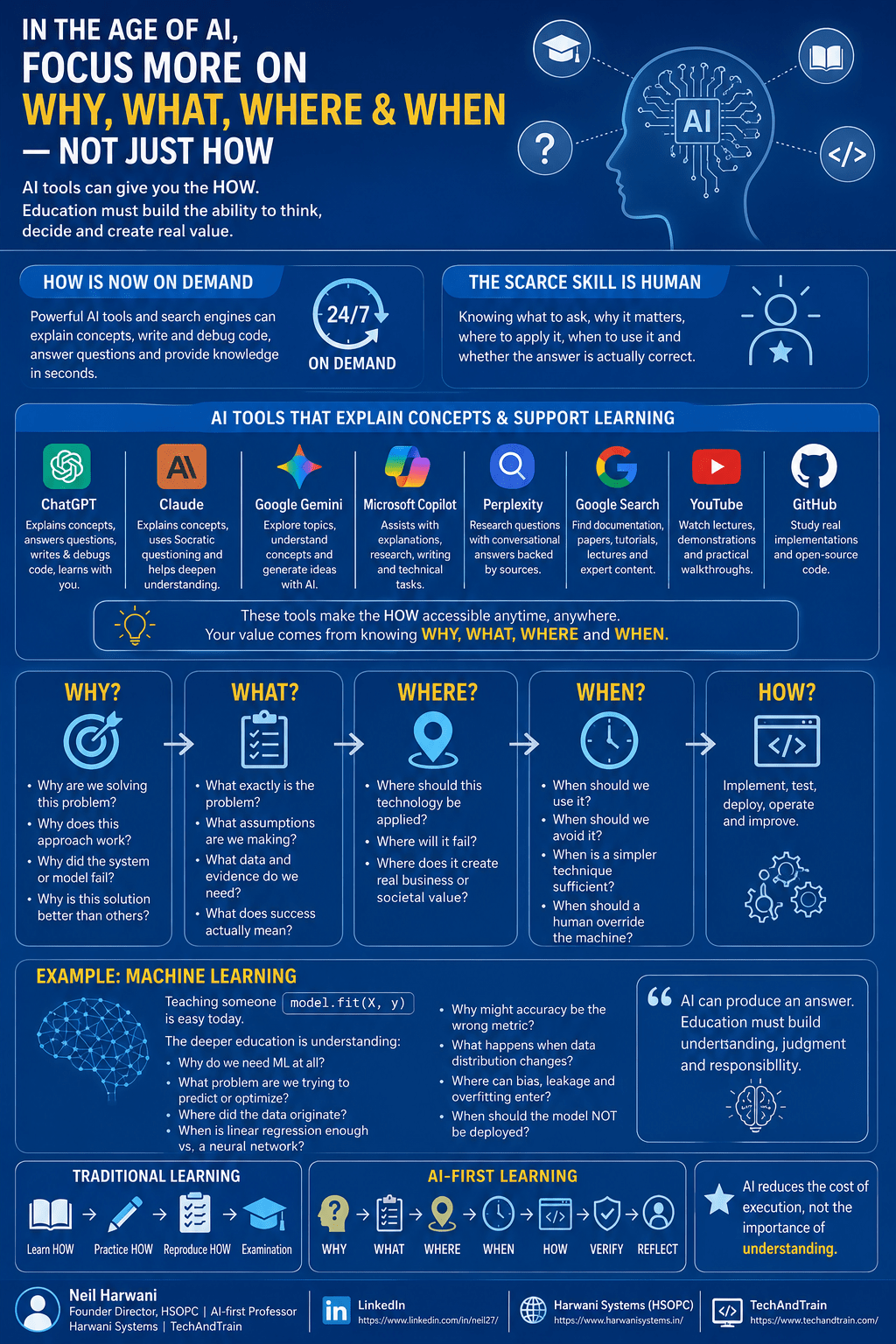
When AI Knows the HOW, Education Must Teach the WHY

In the age of AI, should education spend more time on WHY, WHAT, WHERE and WHEN — rather than only HOW?

For decades, technical education has focused heavily on HOW.

How do you write the code? How do you implement an algorithm? How do you calculate the answer? How do you configure or deploy the system?

HOW still matters — but access to HOW has fundamentally changed.

Today, a learner can ask:

  • ChatGPT — explain concepts, reason through problems, learn math/science, write and debug code.
  • Claude — explain concepts, ask Socratic questions and help develop understanding.
  • Google Gemini — explore and understand topics using generative AI.
  • Microsoft Copilot — assist with explanations, research, writing and technical work.
  • Perplexity — research questions through conversational answers backed by sources.
  • Google Search — find documentation, papers, tutorials, lectures and expert discussions.
  • YouTube — access lectures, demonstrations and practical walkthroughs.
  • GitHub — study real implementations and open-source code.

ChatGPT explicitly supports answering questions and explaining concepts, while Anthropic’s education work with Claude emphasizes guiding students, Socratic questioning and understanding fundamental principles.

So HOW is increasingly available on demand.

The scarce skill is increasingly knowing what to ask, why it matters, where to apply it, when to use it — and whether the answer is actually correct.

WHY?

Why are we solving this problem? Why does this technique work? Why did the system or model fail? Why is this solution preferable to another?

WHAT?

What exactly is the problem? What assumptions are being made? What data do we need? What does success actually mean?

WHERE?

Where should this technology be applied? Where will it fail? Where does it create genuine business or societal value?

WHEN?

When should we use it? When should we avoid it? When is a simpler technique sufficient? When should a human override the machine?

And then — HOW?

How do we implement, test, deploy, operate and improve it?

Consider Machine Learning.

Teaching someone:

model.fit(X, y)

is relatively easy today.

The deeper education is:

WHY do we need ML at all? → WHAT problem are we actually trying to predict or optimize? → WHERE did the data originate? → WHEN is linear regression sufficient instead of a neural network? → Why might accuracy be the wrong metric? → What happens when the data distribution changes? → Where can bias, leakage and overfitting enter the system? → When should the model not be deployed?

This distinction becomes even more important because AI assistance can produce an answer without guaranteeing that the learner understands it. Anthropic’s research on coding education found stronger mastery among participants who used AI to build comprehension — asking conceptual questions and requesting explanations — rather than simply using it to produce code.

That suggests a different model for education:

Traditional: Learn HOW → Practice HOW → Reproduce HOW → Examination

AI-first learning: WHY → WHAT → WHERE → WHEN → HOW → VERIFY → REFLECT

AI can dramatically reduce the cost and time of HOW.

But it increases the importance of fundamentals, judgment, context, critical thinking, verification and responsibility.

The future of education should therefore not be about teaching students less because AI exists.

It should be about teaching them to think at a higher level because AI exists.

AI should reduce the cost of execution — not the importance of understanding.

Neil Harwani

🔗 LinkedIn: https://www.linkedin.com/in/neil27/ 🔗 Harwani Systems (HSOPC): https://www.harwanisystems.in/ 🔗 TechAndTrain: https://www.techandtrain.com/

#AI #Education #AIFirst #MachineLearning #DataScience #GenerativeAI #Teaching #Learning #CriticalThinking #HigherEducation #Engineering #Technology #FutureOfEducation

Concept & Narrative Credit: Neil Harwani

Creation Help: ChatGPT

📢 Stay informed:

From Transformers to AI Agents: Practical Roadmap to Modern Large Language Models (LLMs) – Faculty Development Program at Rashtriya Raksha University

From Transformers to AI Agents: Practical Roadmap to Modern Large Language Models (LLMs) – Notes from Faculty Development Program / Short Term Training Program (Generative AI – From Foundations to Frontiers) that I attended at Rashtriya Raksha University

Article content
Article content

Artificial Intelligence is evolving rapidly. What began with language prediction has now expanded into multimodal reasoning, autonomous agents, and enterprise AI systems. Understanding the complete ecosystem—not just ChatGPT—is becoming an essential skill for engineers, researchers, architects, and business leaders.

1. LLM Internals – How an LLM Actually Works

  • Data collection → cleaning → tokenization
  • Tokens converted into embeddings (dense vectors)
  • Positional encoding preserves sequence information
  • Transformer architecture using:
  • Next-token prediction using Softmax probabilities
  • Training via gradient descent and backpropagation
  • Inference through autoregressive generation

Key idea: LLMs do not memorize sentences—they learn statistical relationships among billions of tokens.


2. Mathematics Behind LLMs

Modern LLMs combine mathematics from multiple disciplines:

  • Linear Algebra (vectors, matrices, tensors)
  • Calculus (gradients, derivatives)
  • Probability & Statistics
  • Information Theory (Entropy, Cross-Entropy)
  • Optimization (Gradient Descent, Adam)
  • Graph Theory
  • Numerical Computing
  • High-dimensional Geometry

Core mathematical concepts

  • Embeddings
  • Attention mechanism
  • Softmax
  • Loss functions
  • Cosine similarity
  • Matrix multiplication
  • Eigenvectors & Singular Value Decomposition (SVD)

Mathematics remains the foundation behind every AI model.


3. Multimodal LLMs

Today’s AI models understand much more than text.

They can process:

  • Text
  • Images
  • Audio
  • Video
  • Documents (PDFs)
  • Tables
  • Source code
  • Structured enterprise data

Applications include:

  • Medical diagnostics
  • Autonomous vehicles
  • Satellite & GeoAI
  • Robotics
  • Scientific research
  • Digital assistants

4. Fine-Tuning

Organizations often adapt foundation models to their specific domains.

Popular approaches include:

  • Full Fine-Tuning
  • Parameter-Efficient Fine-Tuning (PEFT)
  • LoRA
  • QLoRA
  • Instruction Tuning
  • Reinforcement Learning from Human Feedback (RLHF)
  • Preference Optimization (e.g., DPO)

Fine-tuning helps models learn organizational knowledge, terminology, and task-specific behavior.


5. Enterprise Applications

LLMs are transforming almost every industry.

Examples include:

  • Customer support
  • Knowledge management
  • Software development
  • Healthcare
  • Finance
  • Manufacturing
  • Legal document analysis
  • Education
  • Cybersecurity
  • Scientific discovery
  • Government services
  • Geospatial intelligence (GeoAI)

6. Retrieval-Augmented Generation (RAG)

Instead of relying only on training knowledge, RAG retrieves relevant information before generating a response.

Typical pipeline: Documents → Chunking → Embeddings → Vector Database → Retrieval → Prompt Construction → LLM → Answer

Benefits:

  • More accurate responses
  • Reduced hallucinations
  • Access to current enterprise knowledge
  • Better explainability

7. Common RAG Patterns

Modern RAG systems use increasingly sophisticated architectures.

Examples include:

  • Naïve RAG
  • Semantic Search RAG
  • Hybrid Search (Keyword + Vector)
  • Parent–Child Retrieval
  • Multi-Vector Retrieval
  • Graph RAG
  • Knowledge Graph RAG
  • Agentic RAG
  • Corrective RAG (CRAG)
  • Self-RAG
  • Multi-hop RAG
  • Hierarchical RAG
  • Multimodal RAG

The trend is shifting from “search then answer” to intelligent reasoning over enterprise knowledge.


8. AI Agents

Unlike traditional chatbots, AI agents can plan, reason, and execute tasks.

Agent capabilities include:

  • Planning
  • Tool usage
  • Multi-step reasoning
  • Memory
  • Reflection
  • Self-correction
  • Collaboration with other agents

Common frameworks:

  • LangGraph
  • CrewAI
  • AutoGen
  • Semantic Kernel
  • OpenAI Agents SDK

Agents are moving AI from conversation to autonomous execution.


9. Model Context Protocol (MCP)

MCP is emerging as a standardized way for AI models to interact with external systems.

It enables models to securely connect with:

  • Databases
  • APIs
  • Git repositories
  • Local files
  • Enterprise applications
  • Business workflows
  • Development tools

Think of MCP as a “USB-C for AI,” providing a common interface between models and tools.


10. Ethics & Responsible AI

As AI capabilities expand, responsible development becomes increasingly important.

Key principles:

  • Fairness
  • Transparency
  • Explainability
  • Privacy
  • Security
  • Bias mitigation
  • Human oversight
  • Accountability
  • Regulatory compliance
  • Sustainability

Responsible AI is not optional—it is fundamental to building trustworthy systems.


Final Thoughts

The future of AI lies at the intersection of Transformers, Mathematics, Multimodal Intelligence, Fine-Tuning, RAG, AI Agents, MCP, and Responsible AI. Professionals who understand these interconnected concepts will be well-positioned to design the next generation of intelligent systems that are accurate, scalable, secure, and impactful.

The next wave of AI is not just about larger models—it is about smarter architectures, richer context, reliable reasoning, and responsible deployment.

Here is a curated list of technical keywords from the topics in this FDP & Article:

LLM Internals & Mathematics

  • Self-Attention Mechanism
  • Transformer Architecture
  • Positional Encoding (e.g., RoPE)
  • Softmax Function
  • Gradient Descent
  • Cross-Entropy Loss
  • Backpropagation
  • Stochastic Gradient Descent (SGD)
  • Backprop-through-time (BPTT)
  • Layer Normalization

Multi-Modal LLMs

  • Cross-Attention
  • Vision-Language Pre-training (VLP)
  • Contrastive Learning (e.g., CLIP)
  • Modality Alignment
  • Vector Quantization

Fine-Tuning

  • Parameter-Efficient Fine-Tuning (PEFT)
  • Low-Rank Adaptation (LoRA)
  • Quantized LoRA (QLoRA)
  • Reinforcement Learning from Human Feedback (RLHF)
  • Direct Preference Optimization (DPO)
  • Supervised Fine-Tuning (SFT)

Applications & RAG (Retrieval-Augmented Generation) Patterns

  • Vector Embeddings
  • Cosine Similarity
  • Approximate Nearest Neighbor (ANN)
  • Dense Retrieval
  • Hybrid Search (Lexical + Semantic)
  • Re-ranking Models (Cross-Encoders)
  • Context Window Constraints
  • Query Transformation

Agents & MCP (Model Context Protocol)

  • ReAct Framework (Reasoning and Acting)
  • Tool Calling / Function Calling
  • Autonomous Agents
  • Chain-of-Thought (CoT)
  • Model Context Protocol (MCP)
  • State Machine Routing

Ethics in AI

  • Algorithmic Bias
  • Differential Privacy
  • Alignment Problem
  • Data Provenance
  • Hallucination Mitigation
  • Toxicity Scoring

Thank you to all the speakers and staff at RRU.

Dr. Ravi Sheth | LinkedIn School of Information Technology, Artificial Intelligence and Cyber Security (SITAICS): Overview | LinkedIn Gujarat Council on Science and Technology (GUJCOST) | LinkedIn Government of Gujarat: Overview | LinkedIn Rashtriya Raksha University: Overview | LinkedIn Ankita Kapadia | LinkedIn Ankush Chander | LinkedIn Sandip Modha | LinkedIn Bhavesh Patel | LinkedIn Dr. Nikunj Tahilramani | LinkedIn Pragnesh Prajapati | LinkedIn Nirali Khoda | LinkedIn Rajesh Gupta | LinkedIn Mayur Makwana | LinkedIn Dr. Chandresh Parekh | LinkedIn

#ArtificialIntelligence #GenerativeAI #LLM #MachineLearning #DataScience #RAG #AIAgents #MCP #ResponsibleAI #GeoAI #DeepLearning #Research #HigherEducation #EnterpriseAI #FutureOfWork

Concept Credit: Neil Harwani (Article) & Rashtriya Raksha University (FDP / Short term course)

Creation Help: ChatGPT, XMind and Gemini

📢 Stay informed:

Mathematics for Computer Science and Data Science – Sunday Mathematics: #2

Mathematics for Computer Science and Data Science

Why, What, Where, When and How These Concepts Matter

Post #1 on Sunday Mathematics here.

Data Science is much more than learning Python, SQL, or Machine Learning libraries. Mathematics provides the foundation that helps us understand why algorithms work, when to use them, and how to interpret results correctly. The following areas form the mathematical backbone of modern Data Science, AI, Computer Science, and GeoAI.


1. Linear Algebra – The Language of Data

Why?

Most datasets, images, videos, documents, and neural networks are represented as matrices and vectors.

What?

  • Vectors and matrices
  • Eigenvalues and eigenvectors
  • Matrix decompositions (SVD, QR, LU)
  • Dimensionality reduction (PCA)

Where?

  • Machine Learning
  • Deep Learning
  • Recommendation Systems
  • Computer Vision
  • Search Engines

Example

A photograph is simply a matrix of pixel values. PCA compresses large datasets while retaining important information.


2. Probability and Statistics – Managing Uncertainty

Why?

Real-world data is noisy and uncertain. Probability helps us quantify uncertainty and make informed decisions.

What?

  • Probability distributions
  • Bayes Theorem
  • Hypothesis testing
  • Confidence intervals
  • Regression models

Where?

  • Risk analysis
  • Medical diagnosis
  • Forecasting
  • Business analytics

Example

When Netflix recommends a movie, it predicts the probability that you will like it.


3. Calculus and Optimization – Learning from Data

Why?

Machine Learning models learn by minimizing errors.

What?

  • Derivatives and gradients
  • Partial derivatives
  • Gradient Descent
  • Convex optimization
  • Lagrange multipliers

Where?

  • Neural Networks
  • Deep Learning
  • Reinforcement Learning
  • Operations Research

Example

Training a neural network is like repeatedly walking downhill on an error landscape until the lowest error point is reached.


4. Discrete Mathematics – Logic of Computing

Why?

Computers work using logic, sets, graphs, and discrete structures rather than continuous mathematics.

What?

  • Mathematical logic
  • Set theory
  • Relations and functions
  • Graph theory
  • Combinatorics

Where?

  • Algorithms
  • Databases
  • Cybersecurity
  • Network analysis

Example

Social media friendship networks are graphs where people are nodes and relationships are edges.


5. Time Series Analysis – Understanding Change Over Time

Why?

Many datasets evolve with time.

What?

  • AR, MA, ARIMA models
  • Autocorrelation
  • Seasonality
  • Fourier Analysis
  • Spectral analysis

Where?

  • Stock markets
  • Weather forecasting
  • IoT sensors
  • Demand prediction

Example

Retail companies forecast future sales using historical sales patterns and seasonal trends.


6. Geospatial Mathematics – Understanding Location

Why?

Many decisions depend on “where” things happen.

What?

  • Coordinate systems
  • Map projections
  • Spatial interpolation
  • Spatial topology
  • Geodesic calculations

Where?

  • GPS systems
  • Urban planning
  • Agriculture
  • Disaster management
  • GeoAI

Example

Google Maps uses geospatial mathematics to determine shortest routes and travel times.


7. Category Theory – Mathematics of Abstraction

Why?

As systems become complex, we need higher-level ways to describe relationships and transformations.

What?

  • Objects and morphisms
  • Functors
  • Natural transformations
  • Monoids and monads

Where?

  • Functional programming
  • Distributed systems
  • Data pipelines
  • Advanced AI architectures

Example

Modern software frameworks use composable components that follow principles inspired by category theory.


How Everything Connects

A typical Data Science project uses all these areas:

  1. Linear Algebra stores and transforms data.
  2. Statistics helps understand uncertainty.
  3. Calculus & Optimization train models.
  4. Discrete Mathematics powers algorithms and data structures.
  5. Time Series Analysis handles temporal data.
  6. Geospatial Mathematics adds location intelligence.
  7. Category Theory helps design scalable systems and abstractions.

Final Takeaway

Think of Data Science as building a smart city:

  • Linear Algebra = roads and infrastructure.
  • Statistics = traffic measurements and uncertainty.
  • Calculus = optimization of routes.
  • Discrete Mathematics = traffic rules and network design.
  • Time Series = predicting future traffic.
  • Geospatial Mathematics = maps and navigation.
  • Category Theory = the architectural blueprint connecting everything together.

Together, these mathematical foundations transform raw data into knowledge, predictions, decisions, and intelligent systems.

Brief, practical examples for each major category in the mind map, illustrating how these mathematical concepts are actually used in computer science and data science:

1. Discrete Mathematics

  • Mathematical Logic: Designing the conditional logic (if/else statements) in a software program or optimizing SQL queries.
  • Set Theory and Relations: Managing relational databases, where a database JOIN operation is directly based on the intersection of two sets.
  • Graph Theory: Social network analysis (e.g., how Facebook suggests friends) or GPS navigation apps finding the shortest route using Dijkstra’s algorithm.
  • Combinatorics: Calculating the number of possible password combinations to evaluate cybersecurity strength.

2. Calculus and Optimization

  • Differential Calculus: Gradient Descent in machine learning, which calculates gradients (derivatives) to update weights and minimize error during neural network training.
  • Integral Calculus: Computing the Area Under the ROC Curve (AUC) to measure the performance of a classification model.
  • Mathematical Optimization: Tuning a Support Vector Machine (SVM) classifier to find the optimal hyperplane that separates two classes with the maximum margin.

3. Linear Algebra

  • Vectors and Matrices: Representing an image as a matrix of pixel values so a computer can process it.
  • Eigenvalues and Eigenvectors: Google’s PageRank algorithm, which uses the dominant eigenvector of a web-link matrix to rank webpages in search results.
  • Matrix Decompositions: Singular Value Decomposition (SVD) used in Netflix-style recommendation systems to uncover latent user preferences.
  • Dimensionality Reduction: Principal Component Analysis (PCA), which shrinks a dataset with 100 features down to 3 key features to make it easier to visualize and train.

4. Probability and Statistics

  • Probability Theory: Naive Bayes Classifiers calculating the probability that an incoming email is “Spam” based on the words it contains.
  • Probability Distributions: Using a Poisson Distribution to model and predict the number of users logging into a server during peak hours.
  • Statistical Inference: Running an A/B Test on a website to see if a blue button yields a statistically significant increase in clicks compared to a red button.
  • Regression Analysis: Using Logistic Regression to predict a binary outcome, such as whether a bank customer will default on a loan (Yes/No).

5. Geospatial Mathematics

  • Coordinate Systems and Projections: Converting raw GPS latitude and longitude coordinates into a flat, 2D map projection in Google Maps.
  • Spherical Geometry: Using the Haversine formula to calculate the actual flight path distance between London and New York over the Earth’s curved surface.
  • Spatial Analysis and Interpolation: Kriging to estimate pollution levels at an unmeasured city block based on data from surrounding air-quality sensors.
  • Topology and Spatial Relations: Defining geofences, such as an app triggering a notification when a delivery driver enters a 1-mile radius buffer around your house.

6. Category Theory

  • Fundamental Structures: Ensuring function composition in code is associative (e.g., making sure f(g(x)) behaves reliably in functional programming languages like Haskell or Scala).
  • Functors and Transformations: Using a .map() function in JavaScript or Python to transform every element inside a list without altering the list’s overall structure.
  • Monads and Monoids: Using a Monad to safely handle “Null” values or side effects (like API calls) without crashing a program or using Monoids in big data frameworks (like MapReduce) to parallelize data aggregation.

7. Time Series Analysis

  • Stochastic Processes: Modeling stock price movements as a Random Walk to simulate future market risks.
  • Time Series Modeling: An ARIMA model predicting next month’s electricity demand based on historical usage patterns over the last 5 years.
  • Frequency Domain Analysis: Using Fourier Transforms to clean audio data by converting the sound wave into frequencies and filtering out background hiss/noise.
  • Evaluation and Decomposition: Splitting retail sales data into its baseline trend, seasonal holiday spikes, and random noise to understand true business growth.

Concept Credit: Neil Harwani

Creation Help: ChatGPT, XMind and Gemini

📢 Stay informed:

The Lifelong Learner’s Resource Guide: 30+ Platforms for AI, Data Science, GeoAI, Engineering, Research & Executive Education – 2026 Update

The Lifelong Learner’s Resource Guide: 30+ High-Quality Platforms for Engineering, AI, GeoAI, Research and Management

Learning Has Never Been More Accessible

Over the past two decades working across consulting, products, services, research, architecture, artificial intelligence, data science, and now exploring GeoAI, one observation has remained constant:

The most successful professionals are not necessarily the most knowledgeable—they are the most adaptable learners.

We live in an era where world-class education is available to anyone with an internet connection. Universities, research organizations, governments, technology companies, and professional societies now provide thousands of high-quality learning opportunities, many of them free or highly affordable.

I recently compiled a personal list of learning resources that may be useful for students, working professionals, researchers, entrepreneurs, educators, and lifelong learners.


Global Learning Platforms

MIT OpenCourseWare (MIT OCW)

https://ocw.mit.edu

Free access to thousands of undergraduate and graduate courses from MIT.

LinkedIn Learning

https://www.linkedin.com/learning

Professional courses in technology, business, leadership, project management, and creative skills.

Coursera

https://www.coursera.org

University-backed certifications, professional certificates, and degree programs.

edX

https://www.edx.org

Courses, Professional Certificates, and MicroMasters programs from leading universities.

Khan Academy

https://www.khanacademy.org

Excellent foundation in mathematics, science, economics, and computing.


India’s National Learning Ecosystem

NPTEL

https://nptel.ac.in

Online certification programs delivered by IITs and IISc.

SWAYAM

https://swayam.gov.in

Government of India’s MOOC platform with university-level courses.

IITGN-X

https://sites.iitgn.ac.in/iitgnx

Executive education and eMasters programs from IIT Gandhinagar.

IIT Continuing Education / Executive Education Programs

Examples:

• IIT Delhi CEP: https://cepqip.iitd.ac.in

• IIT Kanpur Online: Home | Online Programs, IIT Kanpur

• IIT Jodhpur: Program Portfolio | Office of Executive Education | IIT Jodhpur

• IIT Bombay: Educational Outreach, IIT Bombay

These programs enable working professionals to learn without taking career breaks.


Space Technology, GIS, Remote Sensing and GeoAI

As I continue exploring GeoAI and satellite-image-based applications in agriculture, flood monitoring, urban planning, and environmental analytics, I found these resources particularly valuable.

Indian Institute of Remote Sensing (IIRS)

https://www.iirs.gov.in

ISRO-supported training in Remote Sensing, GIS, GNSS and Geospatial Technologies.

BISAG-N

https://bisag-n.gov.in

National geospatial applications and training initiatives.

Indian Space Association (ISA)

https://isa.indiaspaceweek.org

Industry and educational programs for India’s growing space ecosystem.

Astronaut Training Workshops

https://workshop.indiaspaceweek.org/Astronaut

Awareness and exposure programs related to human spaceflight.

NASA ARSET

https://appliedsciences.nasa.gov/arset

Remote sensing applications and Earth observation training.

ESA EO College

https://eo-college.org

Earth Observation and satellite data analytics.

Google Earth Engine

https://developers.google.com/earth-engine

Cloud-based planetary-scale geospatial analytics platform.

Esri Academy

https://www.esri.com/training

GIS, ArcGIS and spatial analytics training.


Semiconductor and Emerging Technology Programs

Samsung Semiconductor Development Program

https://iisc-iswdp.org

Industry-academia initiative for semiconductor workforce development.

C-DAC ACTS

https://www.cdac.in/index.aspx?id=ActsCourses

Advanced diploma programs in AI, Cybersecurity, Embedded Systems, HPC and Software Engineering.

BSERC

https://bserc.org

Research, innovation and technology development programs.

ISL

https://isl.ac.in

Programs related to space science and emerging technologies.

IICT

https://iict.edu.in

Technology and engineering education initiatives.

NSRC

https://www.nrsc.gov.in/nrscnew/Training_TC_Overview.php


AI, Machine Learning and Data Science

DeepLearning.AI

https://www.deeplearning.ai

Industry-leading AI and Generative AI courses.

Fast.ai

https://www.fast.ai

Practical deep learning with an emphasis on implementation.

Hugging Face Learn

https://huggingface.co/learn

Modern NLP, LLM and Generative AI learning resources.


Research, Publishing and Academic Skills

Elsevier Researcher Academy

https://researcheracademy.elsevier.com

Research methods, publishing and academic career development.

Professional development training for researchers — via online courses and workshops

https://www.nature.com/masterclasses

Writing, peer review and publishing skills.

IEEE Learning Network

https://iln.ieee.org

Engineering and technology-focused professional learning.

ACM Learning Center

https://learning.acm.org

Computing, software engineering and computer science resources.


Working Professional Degree Programs

BITS Pilani WILP

https://www.bits-pilani.ac.in/wilp

Work Integrated Learning Programs for professionals.

IIT Madras Online Degree

https://study.iitm.ac.in

CODE

IIT Madras Degree Program in Data Science and Applications

Online BS and advanced programs in Data Science and related fields.

IIM Udaipur ePhD

https://www.iimu.ac.in/programs/ephd

Executive doctoral program for working professionals.

ISB Executive FPM (EFPM)

https://www.isb.edu/en/study-isb/post-doctoral/efpm.html

Doctoral-level management research program designed for industry professionals.


Technology, AI, Cloud, Semiconductor & Open-Source Learning Resources

Google Cloud Skills Boost

🔗 https://www.cloudskillsboost.google Cloud, AI, Machine Learning, Data Engineering, Kubernetes, Generative AI, and Google Cloud certifications.

Google Developers

🔗 https://developers.google.com Training resources for Android, Web Development, APIs, AI, Maps Platform, and Google Earth Engine.

Microsoft Learn

🔗 https://learn.microsoft.com Comprehensive learning platform covering Azure, AI, Data, Security, .NET, Power Platform, and DevOps.

AWS Skill Builder

🔗 https://skillbuilder.aws Official Amazon Web Services training portal for cloud architecture, machine learning, DevOps, and security.

Meta Blueprint

🔗 https://www.facebookblueprint.com Learning resources for AI, AR/VR, digital technologies, and Meta platforms.

NVIDIA Deep Learning Institute (DLI)

🔗 https://www.nvidia.com/en-in/learn Industry-leading courses on CUDA, GPU Computing, AI, Deep Learning, Robotics, and Accelerated Computing.

Intel Developer & AI Resources

🔗 https://www.intel.com/content/www/us/en/developer/overview.html Resources covering Edge AI, OpenVINO, AI acceleration, hardware optimization, and intelligent systems.

Qualcomm Developer Network

🔗 https://developer.qualcomm.com Training and development resources for Snapdragon, Embedded Systems, Edge AI, and IoT applications.

Apple Developer

🔗 https://developer.apple.com Official learning ecosystem for iOS, Swift, mobile applications, and Apple platforms.

Oracle University

🔗 https://education.oracle.com Training and certifications in Oracle Database, Java, OCI Cloud, Analytics, and AI technologies.

IBM SkillsBuild

🔗 https://skillsbuild.org Free learning platform for AI, Data Science, Cybersecurity, Cloud Computing, and Professional Skills.

Cisco Networking Academy

🔗 https://www.netacad.com Industry-recognized networking, cybersecurity, automation, and IoT education programs.

Red Hat Training & Certification

🔗 https://www.redhat.com/en/services/training-and-certification Linux, OpenShift, Containers, Kubernetes, Automation, and Enterprise DevOps training.

VMware Learning

🔗 https://www.vmware.com/learning.html Training on virtualization, cloud infrastructure, networking, and modern application platforms.

Databricks Academy

🔗 https://www.databricks.com/learn Courses covering Data Engineering, Lakehouse Architecture, Analytics, and Generative AI.

Snowflake University

🔗 https://learn.snowflake.com Cloud Data Platform, Data Warehousing, Analytics, and Data Engineering learning resources.


Semiconductor & Electronics Learning

TSMC University Relations

🔗 https://www.tsmc.com Resources and academic engagement programs related to semiconductor manufacturing and VLSI ecosystems.

Samsung Innovation Campus

🔗 https://www.samsung.com/in/samsung-innovation-campus Programs covering AI, IoT, Coding, Big Data, and future technology skills.

Samsung Semiconductor

🔗 https://semiconductor.samsung.com Learning resources and insights into semiconductor manufacturing and advanced chip technologies.

Texas Instruments Precision Labs

🔗 https://training.ti.com/ti-precision-labs High-quality training on Analog Electronics, Signal Processing, Power Systems, and Embedded Design.

Analog Devices Learning Center

🔗 https://www.analog.com/en/education.html Educational resources on Analog Electronics, Embedded Systems, Sensors, and Signal Processing.

Infineon Education Portal

🔗 https://community.infineon.com/ Learning resources in Power Electronics, Automotive Electronics, Embedded Systems, and Semiconductors.

NXP Training Academy

🔗 https://community.nxp.com/ Training for Automotive Systems, Embedded Computing, IoT, and Edge Devices.

STMicroelectronics Learning

🔗 https://www.st.com/content/st_com/en/support/learning.html Educational content covering microcontrollers, embedded systems, and industrial electronics.

Cadence Training Services

🔗 https://www.cadence.com/en_US/home/training.html Industry-standard EDA, IC Design, Verification, and Semiconductor Design training.

Synopsys Learning Center

🔗 https://training.synopsys.com/learn Professional learning resources for VLSI Design, Verification, EDA Tools, and Semiconductor Engineering.


AI, Research & Open Source

OpenAI Academy

🔗 https://academy.openai.com Learning resources on Generative AI, LLMs, AI applications, and AI adoption.

Hugging Face Learn

🔗 https://huggingface.co/learn Hands-on courses covering NLP, Transformers, Large Language Models, and Open-Source AI.

DeepLearning.AI

🔗 https://www.deeplearning.ai Industry-leading courses on Machine Learning, Deep Learning, LLMs, and Generative AI.

Linux Foundation Training

🔗 https://training.linuxfoundation.org Open-source learning programs covering Linux, Kubernetes, Cloud Native Computing, and DevOps.

Apache Software Foundation

🔗 https://www.apache.org Open-source projects, technical documentation, and community resources across the Apache ecosystem.


My Recommended Learning Sequence

  1. Mathematics & Computing Foundations
  2. Programming & Software Engineering
  3. Cloud & DevOps
  4. Artificial Intelligence & Data Science
  5. Electronics & Embedded Systems
  6. Semiconductors & VLSI
  7. GeoAI & Spatial Analytics
  8. Open Source Technologies
  9. Research Methodology & Publications
  10. Advanced Industry and Academic Research

Final Thoughts

Technology cycles are becoming shorter.

AI models evolve every few months.

Industries transform rapidly.

The ability to learn, unlearn and relearn has become one of the most important professional skills.

Whether your interests lie in Artificial Intelligence, Data Science, GeoAI, Software Engineering, Management, Space Technologies, Research Methodology, Semiconductors, or Executive Education, there has never been a better time to build expertise through structured learning.

The challenge today is no longer access to knowledge.

The challenge is developing a habit of continuous learning.

What platforms, programs, certifications or courses have contributed most to your professional growth?

I would love to hear recommendations from fellow professionals, researchers, educators and students.

#LifelongLearning #ContinuousLearning #ArtificialIntelligence #DataScience #GeoAI #Engineering #Research #HigherEducation #ExecutiveEducation #FutureSkills

📢 Stay informed:

🚕 From Traffic Prediction to Decision Intelligence — A Graph ML Story

Below are insights from my open book assignment / exam at IIT GNX converted into a blog-based story with help on AI/GenAI. This was the most exciting open book assignment / exam given by me till now. Open to comments, suggestions, ideas, debates, improvements, corrections, reviews, etc. Feel free to email me (refer contact detail in the bottom of this article) or message me on LinkedIn.

📌 The Real Question Isn’t Prediction — It’s Decision

Most data science projects stop at:

“Model accuracy improved.”

But in real systems—especially ride-hailing, logistics, BFSI, or infra platforms—that’s not enough.

The real question is:

What decision becomes better because of this model?

This assignment pushed me to think differently.

Instead of just predicting traffic, I asked:

How can traffic forecasts drive real operational decisions in a ride-hailing system?


🧠 Problem Framing (What Actually Matters)

We used the METR-LA dataset:

  • 207 traffic sensors
  • 5-minute interval readings
  • ~4 months of data
  • Objective: predict traffic speeds 5, 15, 30 minutes ahead

But here’s the twist:

👉 Each sensor is not independent 👉 Roads are connected systems 👉 Congestion spreads like a graph

So instead of treating data as rows in a table…

We treat it as a graph system


🌐 Thinking in Graphs (Systems Thinking)

  • Nodes → Traffic sensors
  • Edges → Road proximity / connectivity
  • Signals → Speed over time

This is where complex systems + spatial thinking come into play.

Traffic ≠ isolated events Traffic = propagating behavior across a network


📊 What the Data Told Us

From exploratory analysis:

  • Congestion appears in clusters (not random points)
  • Patterns repeat during commute peaks
  • Slowdowns are both: Temporal (time-based) Spatial (location-based)

👉 This is critical insight for operations:

  • Time tells you when to act
  • Space tells you where to act

🤖 Models We Tested (Keep It Honest)

To make this real (not overhyped), we compared:

1. Persistence Model

  • “Tomorrow ≈ Today”
  • Surprisingly strong for 5-minute prediction

2. Random Forest

  • Uses past lag features
  • Captures non-linear temporal patterns

3. Graph ML Model (GConvGRU)

  • Combines: Graph Convolution → spatial relationships GRU → temporal dynamics

📈 Results (Where Graph ML Actually Matters)

From the results:

Horizon Best Insight (Labels)

5 min Simple models work well

15 min Graph ML starts winning

30 min Graph ML clearly better

👉 Why?

Because:

Short-term = inertia Medium-term = propagation

Graph models capture how congestion spreads, not just how it exists.


🚕 Turning Predictions into Decisions

This is where the project becomes real.

🔴 If congestion is predicted in next 15–30 mins:

  • Reduce driver inflow into that corridor
  • Increase ETA buffers
  • Trigger incentives in nearby zones

🟢 What this enables:

  • Better ETA reliability
  • Smarter driver utilization
  • Reduced customer wait time
  • Proactive—not reactive—operations

🧩 The Big Shift: Model → Decision System

This project is NOT just:

“Train model → predict → done”

It is:

EDA → Model → Evaluation → Business Rules → Decision Intelligence

The work is framed as a decision-intelligence exercise rather than only model-building


⚠️ Reality Check (Limitations)

Let’s stay grounded.

The dataset does NOT include:

  • Ride demand
  • Driver availability
  • Weather
  • Events
  • Airport queues

So:

This is traffic intelligence, not full business optimization


🔧 What I Learned (Real Engineering Insights)

From my own notes:

  • Training time is real (hours, not minutes)
  • GPU/TPU selection matters
  • Early stopping is critical (overfitting is silent killer)
  • Graph ML pipelines are non-trivial systems
  • LLMs can accelerate development—but thinking is still yours

🏗️ Architecture Thinking (My Take)

What excites me most is not the model.

It’s the system design potential:

Imagine combining this with:

  • Real-time driver GPS
  • Demand prediction models
  • Event/weather APIs
  • Reinforcement learning for dispatch

👉 You get:

Autonomous Decision Systems for Urban Mobility


🔮 Where This Connects to My Larger Work

This directly aligns with what I’m exploring:

Agentic AI + Graph Systems + Probabilistic Models for Autonomous Debugging & Decision Systems

Traffic is just one domain.

Same thinking applies to:

  • Microservices failures
  • Network congestion
  • Financial risk propagation
  • Supply chain disruptions

🧠 Final Thought

A staff engineer once asked:

“What gets harder after this lands?”

For me, this project answered a deeper question:

What gets smarter after this lands?


📌 Bottom Line

  • Graph ML is not just “better ML”
  • It is better system understanding
  • Real value comes when: Predictions → Decisions Models → Actions Data → Intelligence

📢 Stay informed:

#GraphML #DataScience #AI #SpatialDataScience #RideHailing #DecisionIntelligence #SystemsThinking #GNN #MachineLearning #TechLeadership

Learnings from assignments / open book exams at Indian Institute of Technology Gandhinagar – Executive Masters in Data Science for Decision Making

One important lesson I learned while working with spatio-temporal graph data on the METR-LA dataset during my Executive Masters open-book assignment:

Do not keep switching between Claude, ChatGPT, Perplexity, Gemini, and other LLMs or AI tools during the execution stage. This lesson has repeated itself in the two years throughout the Executive Masters whenever we have been allowed to use LLMs.

My learning:

• Different LLMs reason differently

• They are trained and fine-tuned differently

• They suggest different libraries, assumptions, fixes, and coding styles

• Mixing their guidance during debugging can create unnecessary chaos

• What looks like “more intelligence” can become “more confusion”

• Multi-model thinking is useful during brainstorming

• It helps in debating, exploring, comparing, and expanding ideas

• But once execution begins, consistency matters more than variety

• Pick one model and work through the problem step by step

• Ask it to explain, debug, simplify, correct, and iterate

• Stay with one reasoning path until the solution stabilizes

My conclusion:

Use multiple LLMs for exploration.

Use one LLM for execution.

Mixing models during ideation can create insight.

Mixing models during implementation can create chaos.

This is especially true in technical work involving data science, graph ML, spatio-temporal modeling, package dependencies, tensor shapes, runtime environments, and debugging.

Progress comes from disciplined iteration, not tool-hopping.

Note: Enhanced / compiled with help of AI / LLMs

Dimensions for Artificial Intelligence / GenAI / LLMs / Deep Learning / Neural Networks / Data Science to ponder on – Part 1-Assisted by AI – ChatGPT


🧠 1. Model Performance & Quality

Beyond accuracy:

  • Precision / Recall / F1-score
  • ROC-AUC
  • Calibration (probability correctness)
  • Generalization ability
  • Robustness (noise, adversarial inputs)
  • Stability (variance across runs)
  • Overfitting / Underfitting control
  • Latency (response time)
  • Throughput (requests per second)

⚖️ 2. Responsible AI / Ethics

Along with fairness, bias, explainability, interpretability:

  • Accountability
  • Transparency
  • Non-discrimination
  • Inclusiveness
  • Human oversight / Human-in-the-loop
  • Ethical alignment
  • Value alignment (especially for LLMs)
  • Safety (harm prevention)

🔐 3. Security & Privacy

Critical for enterprise and GenAI:

  • Data privacy (PII protection)
  • Differential privacy
  • Federated learning capability
  • Model security (model theft, extraction)
  • Prompt injection resistance (LLMs)
  • Data leakage prevention
  • Adversarial robustness
  • Access control & authentication

📊 4. Data Quality & Governance

Often more important than model itself:

  • Data completeness
  • Data consistency
  • Data lineage
  • Data drift detection
  • Concept drift detection
  • Bias in training data
  • Data freshness
  • Label quality
  • Auditability

⚙️ 5. Model Lifecycle & MLOps

Operational excellence:

  • Reproducibility
  • Versioning (data + model)
  • Monitoring (real-time + batch)
  • Model retraining strategy
  • Deployment reliability
  • Rollback capability
  • CI/CD for ML pipelines
  • Observability (logs, metrics, traces)

🧩 6. LLM / GenAI Specific Parameters

Very important for your GenAI work:

  • Hallucination rate
  • Faithfulness (groundedness to source)
  • Context retention (long context handling)
  • Instruction following
  • Toxicity / harmful output control
  • Prompt sensitivity
  • Response consistency
  • Token efficiency (cost optimization)
  • Alignment with system prompts / policies
  • Retrieval quality (RAG precision/recall)

🧪 7. Evaluation & Testing

For enterprise-grade systems:

  • Benchmarking (standard datasets)
  • Stress testing
  • Edge case coverage
  • Scenario testing
  • A/B testing
  • Human evaluation (subjective scoring)
  • Red teaming (especially for GenAI)

🌐 8. Business & Product Metrics

Often ignored in technical discussions:

  • ROI / Cost-benefit
  • User satisfaction
  • Adoption rate
  • Time saved / productivity gain
  • Decision impact quality
  • Revenue impact
  • Risk reduction

🧭 9. Governance & Compliance

Especially relevant in India (DPDP Act etc.):

  • Regulatory compliance
  • Audit trails
  • Model documentation (Model Cards)
  • Explainability for regulators
  • Consent management
  • Data residency

🧠 Quick Memory Framework

You can compress everything into:

👉 FAPES-DLMGB

  • Fairness & Ethics
  • Accuracy & Performance
  • Privacy & Security
  • Explainability
  • Scalability & Stability
  • Data Quality
  • Lifecycle (MLOps)
  • Monitoring
  • Governance
  • Business Impact

Reference frameworks:

  • NIST AI Risk Management Framework
  • ISO/IEC 42001

Note: Enhanced / compiled with help of AI / LLMs