
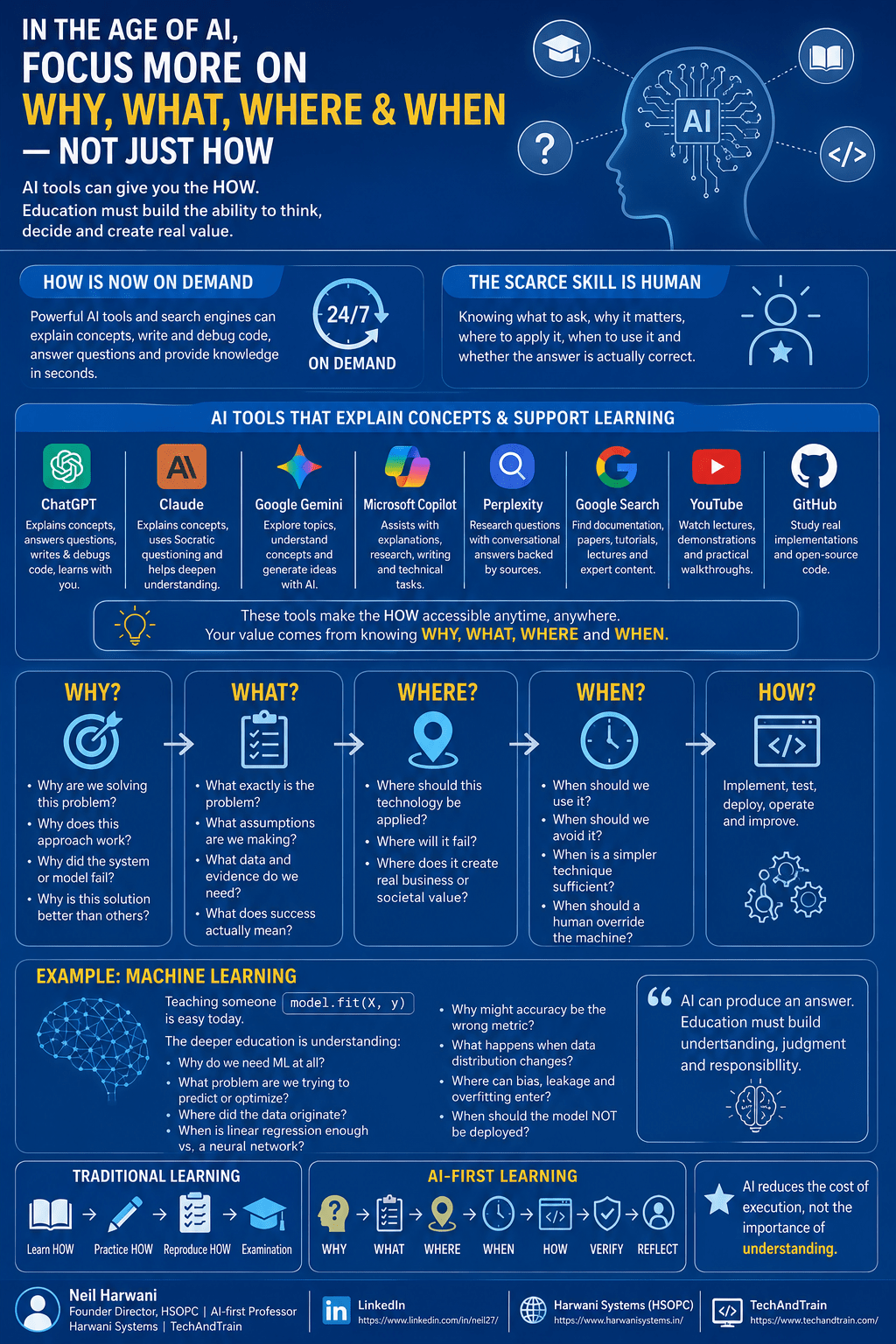
In the age of AI, should education spend more time on WHY, WHAT, WHERE and WHEN — rather than only HOW?
For decades, technical education has focused heavily on HOW.
How do you write the code? How do you implement an algorithm? How do you calculate the answer? How do you configure or deploy the system?
HOW still matters — but access to HOW has fundamentally changed.
Today, a learner can ask:
- ChatGPT — explain concepts, reason through problems, learn math/science, write and debug code.
- Claude — explain concepts, ask Socratic questions and help develop understanding.
- Google Gemini — explore and understand topics using generative AI.
- Microsoft Copilot — assist with explanations, research, writing and technical work.
- Perplexity — research questions through conversational answers backed by sources.
- Google Search — find documentation, papers, tutorials, lectures and expert discussions.
- YouTube — access lectures, demonstrations and practical walkthroughs.
- GitHub — study real implementations and open-source code.
ChatGPT explicitly supports answering questions and explaining concepts, while Anthropic’s education work with Claude emphasizes guiding students, Socratic questioning and understanding fundamental principles.
So HOW is increasingly available on demand.
The scarce skill is increasingly knowing what to ask, why it matters, where to apply it, when to use it — and whether the answer is actually correct.
WHY?
Why are we solving this problem? Why does this technique work? Why did the system or model fail? Why is this solution preferable to another?
WHAT?
What exactly is the problem? What assumptions are being made? What data do we need? What does success actually mean?
WHERE?
Where should this technology be applied? Where will it fail? Where does it create genuine business or societal value?
WHEN?
When should we use it? When should we avoid it? When is a simpler technique sufficient? When should a human override the machine?
And then — HOW?
How do we implement, test, deploy, operate and improve it?
Consider Machine Learning.
Teaching someone:
model.fit(X, y)
is relatively easy today.
The deeper education is:
→ WHY do we need ML at all? → WHAT problem are we actually trying to predict or optimize? → WHERE did the data originate? → WHEN is linear regression sufficient instead of a neural network? → Why might accuracy be the wrong metric? → What happens when the data distribution changes? → Where can bias, leakage and overfitting enter the system? → When should the model not be deployed?
This distinction becomes even more important because AI assistance can produce an answer without guaranteeing that the learner understands it. Anthropic’s research on coding education found stronger mastery among participants who used AI to build comprehension — asking conceptual questions and requesting explanations — rather than simply using it to produce code.
That suggests a different model for education:
Traditional: Learn HOW → Practice HOW → Reproduce HOW → Examination
AI-first learning: WHY → WHAT → WHERE → WHEN → HOW → VERIFY → REFLECT
AI can dramatically reduce the cost and time of HOW.
But it increases the importance of fundamentals, judgment, context, critical thinking, verification and responsibility.
The future of education should therefore not be about teaching students less because AI exists.
It should be about teaching them to think at a higher level because AI exists.
AI should reduce the cost of execution — not the importance of understanding.
— Neil Harwani
🔗 LinkedIn: https://www.linkedin.com/in/neil27/ 🔗 Harwani Systems (HSOPC): https://www.harwanisystems.in/ 🔗 TechAndTrain: https://www.techandtrain.com/
#AI #Education #AIFirst #MachineLearning #DataScience #GenerativeAI #Teaching #Learning #CriticalThinking #HigherEducation #Engineering #Technology #FutureOfEducation
Concept & Narrative Credit: Neil Harwani
Creation Help: ChatGPT
📢 Stay informed:
- Website: www.HarwaniSystems.in
- Blog: www.TechAndTrain.com/blog
- LinkedIn: Neil Harwani | LinkedIn
- Email me: Neil@HarwaniSystems.in

You must be logged in to post a comment.