That bridge is extremely useful when studying waves, signals, electrical systems, communications and control systems.
4. Complex Numbers and Rotation
Suppose:
z = re^(iθ)
Multiplying it by:
e^(iφ)
gives:
z’ = re^(i(θ+φ))
In simple terms, multiplication by a complex exponential can rotate a point.
This gives us a very elegant mathematical mechanism for representing rotations.
Instead of repeatedly manipulating sine and cosine equations, many rotation and oscillation problems become multiplication problems.
This idea appears in graphics, robotics, signal processing, physics and engineering.
5. Electrical Engineering and AC Circuits
One of the classic applications of complex numbers is alternating-current circuit analysis.
Electrical quantities such as voltage and current oscillate.
Instead of repeatedly working with expressions such as:
V(t) = V₀ cos(ωt + φ)
engineers can represent oscillating quantities using complex numbers and phasors.
Circuit impedance can be represented as:
Z = R + jX
where:
R = resistance
X = reactance
j represents √−1 in electrical engineering
The magnitude tells us the overall opposition to current, while the phase captures the relationship between voltage and current.
A difficult time-domain problem can often become a much simpler algebraic problem.
6. Signal Processing and Fourier Analysis
Suppose we have audio, vibration, radar, network or sensor data.
A signal that looks complicated in the time domain may actually contain combinations of simpler frequencies.
Fourier analysis decomposes signals into these frequency components.
Complex exponentials provide an elegant representation:
e^(iωt) = cos(ωt) + i sin(ωt)
This idea forms part of the mathematical foundation behind tools such as:
Fourier Transform
Discrete Fourier Transform (DFT)
Fast Fourier Transform (FFT)
These are used across:
Audio processing
Image processing
Telecommunications
Radar
Medical imaging
Vibration analysis
Sensor analytics
Spectral analysis
Scientific computing
Complex numbers therefore help us move between:
Time Domain ↔ Frequency Domain
7. Communication Systems
Modern communication systems depend heavily on amplitude and phase.
Wireless systems can encode information by changing these properties of a carrier signal.
For example, in Quadrature Amplitude Modulation (QAM), symbols can naturally be represented as points on a complex plane.
Think of a transmitted symbol as:
z = I + jQ
where:
I = In-phase component
Q = Quadrature component
The constellation of these complex-valued points represents digital information.
So when your phone communicates using sophisticated wireless networks, complex-number mathematics is operating underneath many layers of abstraction.
8. Control Systems
Complex numbers also appear naturally when studying the stability and behaviour of dynamic systems.
Engineers examine poles and zeros in the complex plane.
A pole might look like:
s = σ + jω
The real component can tell us about growth or decay.
The imaginary component relates to oscillation.
This makes the complex plane extremely useful for reasoning about:
Stability + Oscillation + Damping + System Response
Applications range from industrial automation to aerospace, robotics and power systems.
9. Quantum Mechanics
Complex numbers are fundamental to quantum mechanics.
Quantum states are represented using complex-valued wave functions.
A simplified representation might be:
ψ = a + bi
The directly observable probability is not simply ψ itself.
Instead, quantities involving its magnitude, such as:
|ψ|²
play a central role.
Here complex numbers are not merely a convenient calculation technique—they are embedded deeply in the mathematical framework used to describe quantum systems.
10. Computer Graphics and Robotics
Complex numbers can represent rotations elegantly in two dimensions.
If a point is represented by:
z = x + iy
multiplication by:
e^(iθ)
rotates the point through an angle θ.
This provides a compact way of understanding transformations.
For 3D rotations, related mathematical ideas extend into structures such as quaternions, widely used in robotics, aerospace systems, simulations and computer graphics.
11. Complex Numbers in Data Science and AI
Most introductory machine-learning models operate on real-valued data.
But complex-valued representations become useful when the underlying information naturally contains phase, frequency, waves or spectral characteristics.
Examples can arise in:
Signal classification
Radar analytics
Wireless communications
Medical imaging
MRI reconstruction
Audio processing
Computer vision
Spectral methods
Scientific machine learning
Complex-valued neural networks
This highlights an important lesson for data science:
The mathematical representation should follow the structure of the problem.
If the phenomenon contains magnitude and phase, forcing everything prematurely into purely real-valued representations can sometimes hide useful structure.
12. A Small Python Example
Python supports complex numbers directly.
z = 3 + 4j

print(z.real)
print(z.imag)
print(abs(z))
The result is:
Real part = 3
Imaginary part = 4
Magnitude = 5
Scientific Python libraries such as NumPy can also perform complex-valued numerical computations, Fourier transforms and linear algebra.
So the journey from:
i = √−1
to computational engineering is surprisingly short.
The Bigger Lesson
Complex numbers demonstrate something important about mathematics.
Sometimes mathematics advances not by solving a problem inside the existing system, but by expanding the system itself.
Natural numbers were not enough.
We introduced integers.
Integers were not enough.
We introduced rational numbers.
Rational numbers were not enough.
We introduced real numbers.
And real numbers were not enough.
We introduced complex numbers.
What initially looks “imaginary” can eventually become indispensable for describing reality.
WHY → WHAT → WHERE → WHEN → HOW
For learning complex numbers, I would approach the topic in this order:
WHY? Real numbers alone cannot conveniently represent every mathematical and physical phenomenon.
WHAT? A complex number combines real and imaginary components: a + bi.
WHERE? Signals, circuits, communications, control systems, physics, graphics, robotics and scientific computing.
WHEN? Especially when the problem involves oscillation, rotation, frequency, magnitude and phase.
HOW? Complex algebra, Euler’s formula, polar representation, Fourier analysis—and computational tools such as Python, NumPy, MATLAB and scientific libraries.
AI can increasingly help us with the HOW.
But understanding the WHY and WHAT remains essential if we want to know whether the answer actually makes sense.
Sunday Mathematics
The objective of this series is not mathematics for examinations.
It is mathematics for computer science, data science, AI, engineering, technology and decision-making—connecting equations with the systems around us.
Sunday Mathematics #3: Complex Numbers
From √−1 to signals, circuits, wireless communication, quantum mechanics, robotics and AI.
Sometimes the numbers we call imaginary help us understand the real world.
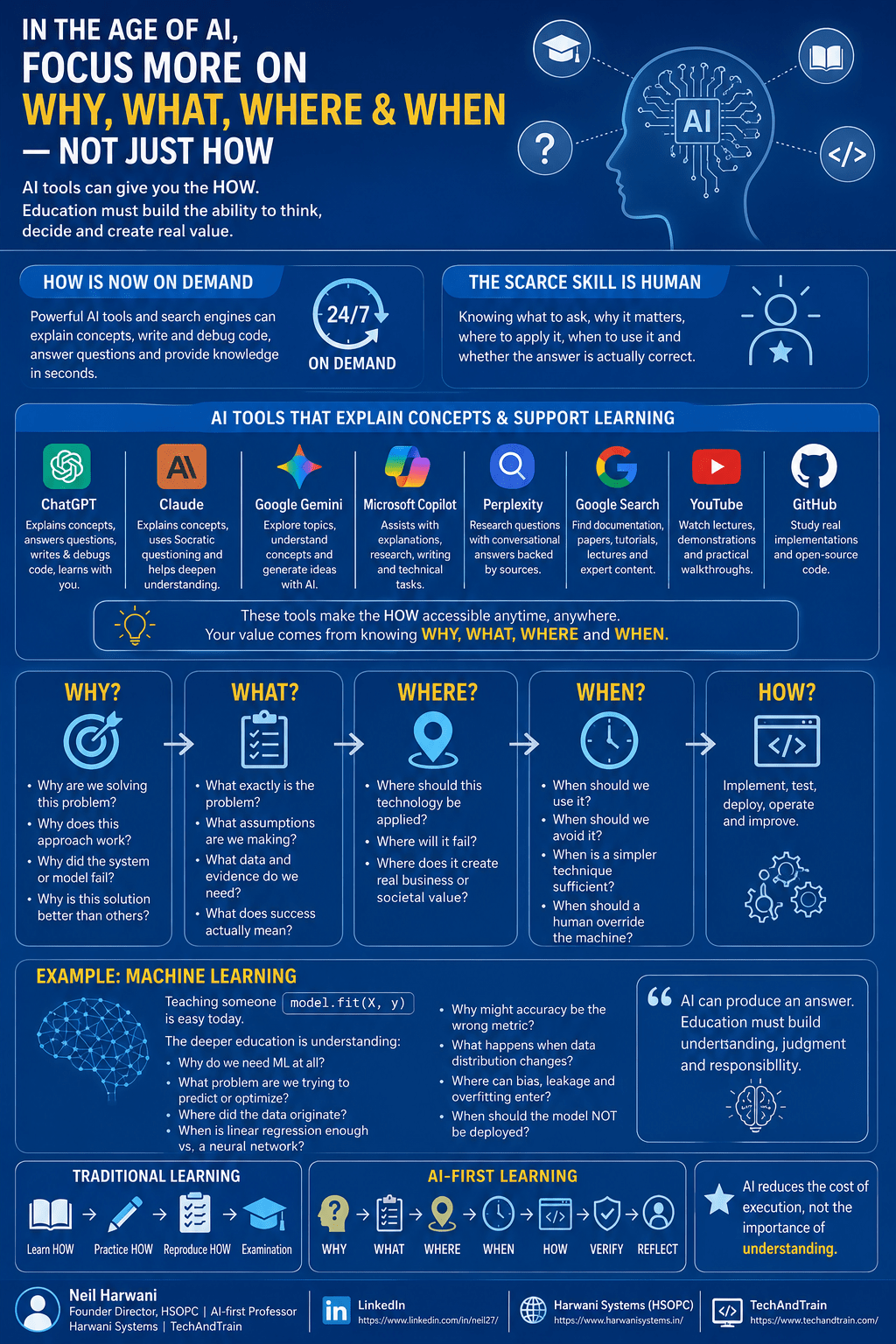
In the age of AI, should education spend more time on WHY, WHAT, WHERE and WHEN — rather than only HOW?
For decades, technical education has focused heavily on HOW.
How do you write the code? How do you implement an algorithm? How do you calculate the answer? How do you configure or deploy the system?
HOW still matters — but access to HOW has fundamentally changed.
Today, a learner can ask:
ChatGPT — explain concepts, reason through problems, learn math/science, write and debug code.
Claude — explain concepts, ask Socratic questions and help develop understanding.
Google Gemini — explore and understand topics using generative AI.
Microsoft Copilot — assist with explanations, research, writing and technical work.
Perplexity — research questions through conversational answers backed by sources.
Google Search — find documentation, papers, tutorials, lectures and expert discussions.
YouTube — access lectures, demonstrations and practical walkthroughs.
GitHub — study real implementations and open-source code.
ChatGPT explicitly supports answering questions and explaining concepts, while Anthropic’s education work with Claude emphasizes guiding students, Socratic questioning and understanding fundamental principles.
So HOW is increasingly available on demand.
The scarce skill is increasingly knowing what to ask, why it matters, where to apply it, when to use it — and whether the answer is actually correct.
WHY?
Why are we solving this problem? Why does this technique work? Why did the system or model fail? Why is this solution preferable to another?
WHAT?
What exactly is the problem? What assumptions are being made? What data do we need? What does success actually mean?
WHERE?
Where should this technology be applied? Where will it fail? Where does it create genuine business or societal value?
WHEN?
When should we use it? When should we avoid it? When is a simpler technique sufficient? When should a human override the machine?
And then — HOW?
How do we implement, test, deploy, operate and improve it?
Consider Machine Learning.
Teaching someone:
model.fit(X, y)
is relatively easy today.
The deeper education is:
→ WHY do we need ML at all? → WHAT problem are we actually trying to predict or optimize? → WHERE did the data originate? → WHEN is linear regression sufficient instead of a neural network? → Why might accuracy be the wrong metric? → What happens when the data distribution changes? → Where can bias, leakage and overfitting enter the system? → When should the model not be deployed?
This distinction becomes even more important because AI assistance can produce an answer without guaranteeing that the learner understands it. Anthropic’s research on coding education found stronger mastery among participants who used AI to build comprehension — asking conceptual questions and requesting explanations — rather than simply using it to produce code.
That suggests a different model for education:
Traditional: Learn HOW → Practice HOW → Reproduce HOW → Examination
AI-first learning:WHY → WHAT → WHERE → WHEN → HOW → VERIFY → REFLECT
AI can dramatically reduce the cost and time of HOW.
But it increases the importance of fundamentals, judgment, context, critical thinking, verification and responsibility.
The future of education should therefore not be about teaching students less because AI exists.
It should be about teaching them to think at a higher level because AI exists.
AI should reduce the cost of execution — not the importance of understanding.
India’s long-term competitiveness will not be determined by universities, startups, corporations or government acting independently.
It will increasingly depend on how effectively we connect them.
This article looks at that opportunity through three interconnected ecosystems:
PART I — INDIA’S UNIVERSITY & KNOWLEDGE ECOSYSTEM
Building the foundations of knowledge, research and talent
India possesses an extraordinary diversity of higher-education institutions.
Its ecosystem includes the IITs, IISc, IISERs, IIMs, AIIMS, central universities, research institutions, specialised institutions and increasingly strong private universities.
Rather than viewing them simply through rankings, placements and entrance examinations, we should view universities as engines through which knowledge progresses:
Learning → Research → Experimentation → Innovation → Entrepreneurship → Industry → Public Policy → Societal Impact
A Broader View of India’s Leading University Ecosystems
University of Delhi, Jawaharlal Nehru University, Banaras Hindu University, Jadavpur University, Jamia Millia Islamia and Aligarh Muslim University.
Private / Deemed University Ecosystems
BITS Pilani, Manipal Academy of Higher Education and Amrita Vishwa Vidyapeetham.
Management & Business
IIM Ahmedabad and IIM Bangalore.
Medicine & Healthcare
AIIMS New Delhi.
This should not be interpreted as another absolute 1-to-25 ranking. Different institutions contribute different capabilities to India’s knowledge ecosystem.
Eight Pillars of a Powerful University Ecosystem
1. Students & Learning — rigorous education combining theory, laboratories, projects, case studies, fieldwork and interdisciplinary problem-solving.
2. Faculty & Research — creating new knowledge through fundamental and applied research, publications, patents and collaboration.
3. Industry — moving beyond placements toward sponsored research, internships, industry laboratories, consulting, datasets and real-world problem statements.
4. Startups & Entrepreneurship — converting ideas and research into enterprises.
5. Government & Public Policy — applying multidisciplinary expertise to agriculture, healthcare, climate, defence, cybersecurity, AI, infrastructure and other national challenges.
6. Alumni — engaging graduates as mentors, investors, recruiters, donors, entrepreneurs and global connectors.
7. Global Universities — creating international research, student mobility, joint laboratories and knowledge networks.
8. Society — ensuring academic excellence ultimately contributes to better technologies, institutions, public systems and quality of life.
The university of the future may therefore be defined less by its campus boundary and increasingly by its network of knowledge, people and institutions.
PART II — GUJARAT’S EDUCATION, RESEARCH & INNOVATION ECOSYSTEM
Connecting specialised institutions into a regional knowledge network
Gujarat presents a fascinating opportunity.
Its strength does not arise from one dominant institution. It has developed a geographically concentrated but intellectually diverse ecosystem spanning engineering, management, design, law, biotechnology, pharmaceuticals, energy, agriculture, urban planning and entrepreneurship.
Consider the capabilities already present.
IIT Gandhinagar
Technology + Science + AI + Engineering + Interdisciplinary Research
IIM Ahmedabad
Management + Strategy + Entrepreneurship + Finance + Public Systems
NID Ahmedabad
Design + Human-Centred Innovation
NIFT Gandhinagar
Design + Fashion + Textiles + Creative Industries
DA-IICT (Now DAU)
ICT + Computing + Data + AI + Communications
PDEU
Energy + Engineering + Sustainability + Technology
Gujarat National Law University
Law + Regulation + Governance + Technology Policy
Gujarat Biotechnology University
Biotechnology + Bioinformatics + Life Sciences
NIPER Ahmedabad
Pharmaceutical Sciences + Drug Research
CEPT University
Architecture + Planning + Cities + Infrastructure
Ahmedabad University
Engineering + Sciences + Management + Humanities
Gujarat University
Scale + Multidisciplinary Education + Research
Nirma University
Engineering + Management + Pharmacy + Law
The wider ecosystem additionally includes institutions such as MS University of Baroda, SVNIT Surat, IITRAM, IRMA Anand, Anand Agricultural University, Gujarat Technological University, CHARUSAT and many other specialised institutions.
IITGN / DA-IICT + GBU + NIPER + Medical Institutions + Pharma Industry
Drug discovery, bioinformatics, medical imaging, clinical analytics and precision medicine.
Smart Cities
CEPT + IITGN + IIMA + DA-IICT + Government + Industry
GIS, digital twins, transportation, IoT, infrastructure, economics and public policy.
Climate & Energy
PDEU + IITGN + IIMA + Industry
Renewables, hydrogen, batteries, smart grids, climate finance and industrial sustainability.
Responsible AI
IITGN + DA-IICT + IIMA + GNLU
AI engineering combined with ethics, governance, economics, privacy, cybersecurity and law.
Product Innovation
IITGN + DA-IICT + NID + IIMA + Industry
Engineering → Design → Business Model → Industry → Market
GIFT City: Another Powerful Layer
GIFT City creates possibilities around:
Universities + BFSI + FinTech + RegTech + AI + Cybersecurity + International Finance + Regulation + Data Science
This could develop into an important FinTech–RegTech–AI research and innovation corridor.
Ahmedabad–Gandhinagar–GIFT City–Anand, and its connections with Vadodara and Surat, could therefore evolve as a powerful knowledge and innovation region.
The next step should not necessarily be another institution.
It should be connective infrastructure between existing institutions.
A Gujarat Innovation Grid could connect laboratories, researchers, patents, datasets, startups, investors, government challenges, industry problems, student projects, incubators, courses and funding opportunities.
The philosophy is simple:
Don’t duplicate every capability at every institution. Connect capabilities.
PART III — INDIA’S ENTREPRENEURIAL & STARTUP ECOSYSTEM
Converting knowledge and innovation into enterprises, employment and impact
This is where the first two parts of the ecosystem converge.
A powerful education system produces knowledge and talent.
A powerful research ecosystem produces discoveries and intellectual property.
But a powerful entrepreneurial ecosystem creates pathways through which some of those ideas become:
Research laboratories can generate intellectual property.
Student projects can generate prototypes.
Industry-sponsored problems can generate solutions.
Faculty research can create technology spin-offs.
This creates a fundamentally different relationship:
University → Research → IP → Incubator → Startup → Investor → Industry → Market
2. Incubators: The Critical Bridge
Incubators occupy a particularly important position between academic innovation and the market.
A serious incubator should provide much more than office space.
It can provide:
Mentorship
Prototype infrastructure
Laboratories
Business-model development
IP and legal assistance
Industry connections
Customer discovery
Investor access
Seed funding
Technology expertise
Founder networks
Market access
The Department of Science & Technology’s NIDHI programme explicitly positions Technology Business Incubators around academic, technical and management institutions as mechanisms for converting innovation into ventures and commercialising research.
The Atal Innovation Mission similarly supports Atal Incubation Centres intended to help innovative startups become scalable and sustainable businesses.
India therefore increasingly has institutional infrastructure connecting innovation with entrepreneurship.
3. A Multi-Layer National Innovation Architecture
One way of visualising India’s emerging ecosystem is:
Schools ↓ Innovation & Tinkering ↓ Universities ↓ Research & Student Innovation ↓ Incubators ↓ Prototype & Validation ↓ Accelerators ↓ Market & Scale ↓ Angel Investors / Venture Capital ↓ Growth Capital ↓ Corporations & Global Markets
Government programmes can support different points in this journey rather than attempting to replace private entrepreneurship.
4. Government-Supported Innovation Infrastructure
Several national mechanisms contribute to this architecture.
Atal Innovation Mission
Atal Innovation Mission has built programmes spanning innovation exposure, incubation and entrepreneurship.
Its official reporting includes thousands of startups supported through its broader ecosystem and a nationwide network of Atal Incubation Centres.
DST–NIDHI
The Department of Science & Technology’s NIDHI programme is particularly important for science and technology entrepreneurship.
Its architecture includes:
NIDHI-PRAYAS — Idea to Prototype
NIDHI-EIR — Entrepreneur in Residence
NIDHI-TBI — Technology Business Incubation
NIDHI-iTBI — Inclusive Technology Business Incubation
NIDHI Seed Support
NIDHI Accelerator
NIDHI Centres of Excellence
This represents an important concept:
Entrepreneurs need different forms of support at different stages.
A researcher developing a prototype needs something very different from a startup preparing for international expansion.
5. University Incubators
Some of India’s most interesting entrepreneurial ecosystems have emerged around major educational institutions.
The broader model can include incubation and entrepreneurship environments associated with IITs, IIMs, IISc, universities and research institutions.
These environments have an advantage traditional accelerators may not always possess:
Research + Laboratories + Professors + Students + Alumni + Technology + Entrepreneurship
The strongest university incubators can therefore become bridges between scientific capability and commercial execution.
6. Private Accelerators and Corporate Innovation
Universities and government incubators represent only part of the ecosystem.
India also needs strong participation from:
Corporations
Accelerators
Angel networks
Venture capital funds
Private equity
Family offices
Banks
Professional-services firms
Technology companies
Industry associations
Successful entrepreneurs
Large corporations can become early customers, technology partners, mentors, investors and eventually acquirers of startups.
This creates another valuable pathway:
Startup → Corporate Pilot → Enterprise Customer → Scale
7. Incubation Must Connect to Industry
One danger is measuring entrepreneurial ecosystems simply by the number of incubators or startups created.
The more meaningful questions are:
How many prototypes became products?
How many products acquired customers?
How many startups survived?
How many technologies were transferred?
How many patents were commercialised?
How many startups expanded internationally?
How many sustainable jobs were created?
How many meaningful societal problems were solved?
The objective is not incubation for incubation’s sake.
The objective is:
Innovation → Adoption → Sustainable Impact
8. DeepTech Requires a Different Model
India’s next entrepreneurial phase should increasingly include DeepTech.
AI, robotics, semiconductors, biotechnology, space technology, quantum technologies, climate technology, advanced materials, cybersecurity, drones and advanced manufacturing often require:
Longer research cycles
Specialised laboratories
Patient capital
Academic collaboration
Government support
Industry validation
Strong intellectual property
Traditional three-month accelerator models alone cannot build many such companies.
This is precisely where India’s university and research ecosystem becomes strategically important.
9. Entrepreneurship Beyond Bengaluru, Delhi and Mumbai
India’s entrepreneurial future should increasingly be distributed.
Ahmedabad–Gandhinagar, Pune, Hyderabad, Chennai, Kochi, Jaipur, Chandigarh, Indore, Bhubaneswar and other knowledge centres can develop specialised innovation clusters.
Regional ecosystems can align with their economic strengths.
A researcher in Gujarat should potentially be able to discover a specialist laboratory in Bengaluru, an investor in Mumbai, a manufacturing partner in Pune, a government programme in Delhi and an international customer in Singapore.
Geography should increasingly cease to be the boundary of the innovation ecosystem.
The Three Ecosystems Must Ultimately Become One
This brings the argument full circle.
PART I — INDIA’S UNIVERSITY ECOSYSTEM
Creates talent and knowledge.
↓
PART II — GUJARAT’S EDUCATION & INNOVATION ECOSYSTEM
Shows what becomes possible when specialised institutions are geographically and intellectually connected.
↓
PART III — INDIA’S ENTREPRENEURIAL ECOSYSTEM
Transforms knowledge and innovation into organisations capable of creating economic and societal value.
And surrounding all three are:
Government + Industry + Investors + Alumni + Global Universities + Society
Perhaps India’s real opportunity is therefore not simply to produce more graduates, more universities, more incubators or even more startups.
It is to increase the quality and density of connections between them.
The Future Is the Ecosystem
Education creates capability.
Research creates knowledge.
Innovation creates possibilities.
Entrepreneurship converts possibilities into action.
Industry provides adoption and scale.
Capital enables growth.
Government creates enabling infrastructure and policy.
Society ultimately determines whether the innovation matters.
Connect these effectively and India does not merely create better universities or more startups.
It creates a knowledge-driven innovation economy.
Education → Research → Innovation → Incubation → Entrepreneurship → Capital → Industry → Scale → Global Impact
References & Ecosystem Links
The institutions, programmes and organisations below provide useful references for exploring India’s education, research, innovation and entrepreneurial ecosystem in greater depth.
1. Leading Indian Education & Research Institutions
2. Gujarat Education, Research & Innovation Ecosystem
Gujarat has an unusually diverse collection of institutions spanning technology, management, design, law, biotechnology, pharmaceuticals, agriculture, energy and urban systems.
GIFT City creates an important opportunity to connect:
Universities + BFSI + FinTech + RegTech + AI + Cybersecurity + Data Science + International Finance + Regulation
This could strengthen an Ahmedabad–Gandhinagar–GIFT City innovation corridor connecting academia, financial institutions, technology companies, startups, regulators and investors.
4. India’s National Startup & Innovation Ecosystem
Startup India is an important national platform connecting entrepreneurs with government initiatives, ecosystem resources, incubators, mentors and investors.
When people ask me, “How do I start a consulting or technology company in India?”, they usually expect a checklist of registrations, taxes and compliance.
Those things are important.
But after nearly a decade of building—from a personal technology blog to an education platform and finally to a technology consulting and research company—I have learned that incorporation is probably the easiest part of building a business.
Building trust is much harder.
This article shares my journey and the lessons learned, which may help aspiring founders, consultants, researchers and technology professionals.
Phase 1: Build Knowledge Before You Build a Company
Around eleven years ago, I wasn’t thinking about building a company.
I simply started writing.
I published technical blogs, created tutorials, contributed to communities, answered questions, mentored students and shared what I learned from enterprise projects.
That eventually evolved into TechAndTrain, a platform focused on learning, technical education and knowledge sharing.
Looking back, this phase created something far more valuable than revenue:
Credibility
Domain expertise
Professional network
Portfolio of work
Teaching experience
Industry visibility
If nobody knows your work, registering a company changes very little.
Knowledge compounds.
Phase 2: Solve Real Problems
Instead of chasing ideas, I focused on solving practical enterprise problems.
Over the years I worked across:
Enterprise Architecture
Open Source Technologies
Digital Experience Platforms
Artificial Intelligence
Cloud
Data Engineering
Government Platforms
BFSI
Healthcare
Manufacturing
Education
Every project taught something new.
Each experience became another building block.
Many founders start with a company and then search for problems.
I believe the opposite works better.
Find meaningful problems first.
Phase 3: Develop Multiple Sources of Credibility
Long before clients evaluate your company, they evaluate you.
Over the years I intentionally invested in multiple forms of credibility:
Industry consulting
Enterprise delivery
Teaching
Speaking engagements
Technical blogging
Open-source contributions
Continuous higher education
Research projects
Mentoring students
Each reinforces the others.
Clients rarely ask only about your company.
They ask about your experience.
Phase 4: Register the Company Only When the Foundation Exists
After years of experience came the formation of Harwani Systems (OPC) Private Limited (HSOPC).
The company wasn’t created because I wanted to become an entrepreneur overnight.
It was created because the work had already begun.
The company simply became the legal structure around years of accumulated expertise.
Today the focus includes:
Technology Consulting
Enterprise Architecture
Artificial Intelligence
Open Source
Research
Executive Education
Strategic Advisory
Digital Transformation
The company is an evolution—not a beginning.
Practical Steps to Set Up a Company in India
For professionals considering a similar journey, here’s a practical roadmap.
1. Validate Your Expertise
Can people clearly explain what you are good at?
Can they recommend you?
Would someone pay for your knowledge?
If not, spend more time building expertise.
2. Build an Online Presence
Your digital footprint matters.
Examples include:
Website
LinkedIn
GitHub
Technical Blog
Research Publications
Portfolio
Case Studies
Videos
Conference Talks
People research you before contacting you.
3. Choose the Right Business Structure
Depending on your goals, consider:
Sole Proprietorship
LLP
One Person Company (OPC)
Private Limited Company
There is no universally “best” structure.
The right choice depends on ownership, funding plans, compliance expectations, liability considerations and future growth.
Professional advice from a Chartered Accountant and Company Secretary is worthwhile before making this decision.
4. Complete Legal Registrations
Typical registrations may include:
MCA Incorporation
PAN
TAN
GST (where applicable)
Bank Account
Professional Tax (state dependent)
Shops & Establishment (where applicable)
Import Export Code (if needed)
Compliance is not exciting.
But it protects the business.
5. Create Essential Documentation
Don’t postpone documentation.
Prepare:
Service Agreements
NDAs
Master Service Agreements
Employment Agreements
Contractor Agreements
Privacy Policy
Website Terms
Proposal Templates
Invoice Templates
Professional documentation creates confidence.
6. Build Systems Early
Don’t wait until you have fifty employees.
Implement systems for:
Accounting
CRM
Project Management
Knowledge Management
Information Security
Password Management
Document Management
AI-assisted productivity
Good systems scale.
Poor habits also scale.
7. Invest in Reputation
Marketing matters.
Reputation matters more.
Reputation comes from:
Delivering consistently
Being ethical
Meeting commitments
Communicating honestly
Admitting mistakes
Sharing knowledge
Trust is the ultimate competitive advantage.
The Biggest Lesson I Learned
Many startups focus almost entirely on valuation.
Others chase funding.
Some pursue rapid hiring.
Our philosophy has evolved differently.
We believe in sustainable, ethical growth.
Rather than building the largest company possible, our objective is to build a company that clients trust, employees enjoy working with, and partners are proud to collaborate with.
Success should not require compromising values.
Advice to First-Time Founders
If I could start again, I would:
Build expertise before branding.
Write more and publish consistently.
Teach whenever possible.
Contribute to open source.
Build relationships before needing them.
Invest in documentation from day one.
Stay financially disciplined.
Focus on long-term credibility over short-term hype.
Treat compliance as an investment, not an expense.
Remember that every satisfied client becomes part of your marketing team.
Final Thoughts
A company is not created on the day it is incorporated.
It begins with every blog written, every student mentored, every project delivered, every problem solved, and every promise kept.
For me, the journey from a personal technology blog to TechAndTrain and eventually to HSOPC has taken nearly eleven years.
The registrations took weeks.
The credibility took a decade.
If you’re planning to start your own company, my advice is simple:
Build knowledge. Build trust. Build systems. The company will follow.




You must be logged in to post a comment.